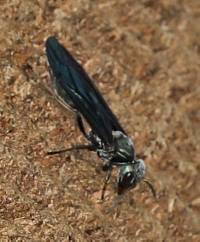
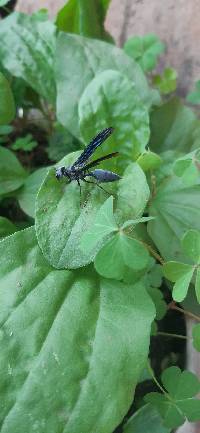
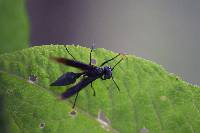
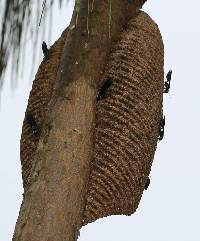
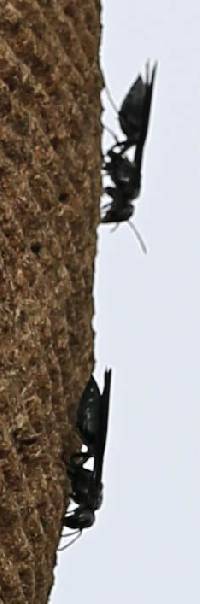
Synoeca septentrionalis is one of five species of wasps in the genus Synoeca. It is a swarm-founding wasp that is also eusocial, exhibiting complicated nest structure and defense mechanisms and a colony cycle including a pre-emergence phase and a post-emergence phase. It is typically found in areas from Central to South America. This wasp is one of the larger species of paper wasps and exhibits multiple morphological adaptations as a result of this. Synoeca septentrionalis is known for possessing an extremely painful sting.
Taxonomy and phylogeny
Synoeca septentrionalis is one of five species of wasp in the genus Synoeca, with the other four being S. chalybea, S. cyanea, S. surinama, and S. virginea. Wasps in the genus Synoeca are often referred to as warrior wasps and are found in various areas in the Americas. Each wasp in the genus exhibits similar characteristics, but from a phylogenetic standpoint, S. septentrionalis is most closely related to S. surinama and S. cyanea. The wasps in this genus are also a part of the paper wasp tribe known as Epiponini, which are Neotropical. In general, the genus is quite aggressive and will often display cohesive defense mechanisms when threatened.
Description and identification
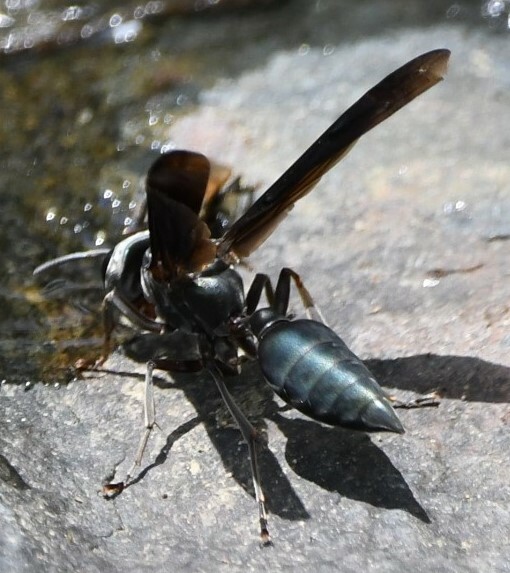
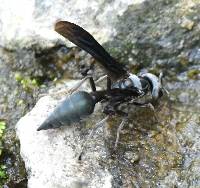
Synoeca septentrionalis exhibits a blackish or dark blue color and has a metallic-like appearance. Their wings are also quite large and are entirely infuscate. Their metasomal tergum (a portion of the abdomen) and sternum both exhibit erect hairs, and their clypeus is imprinted with an area that resembles a dark triangle. Color patterns vary among the species; some exhibit a reddish color, while others are completely darkened. Overall, they are a medium-sized wasp with lengths of approximately 20 millimetres (0.79 in).
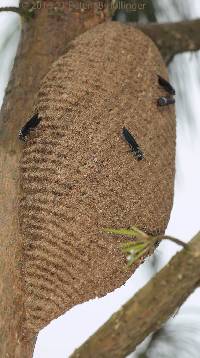
They are considered to be paper wasps, as their nests are made out of paper. Their nests will change as a colony grows. Typically, they will start as one comb within a ridged, domed envelope that also has a hole or holes where other lobes can be added as necessary....