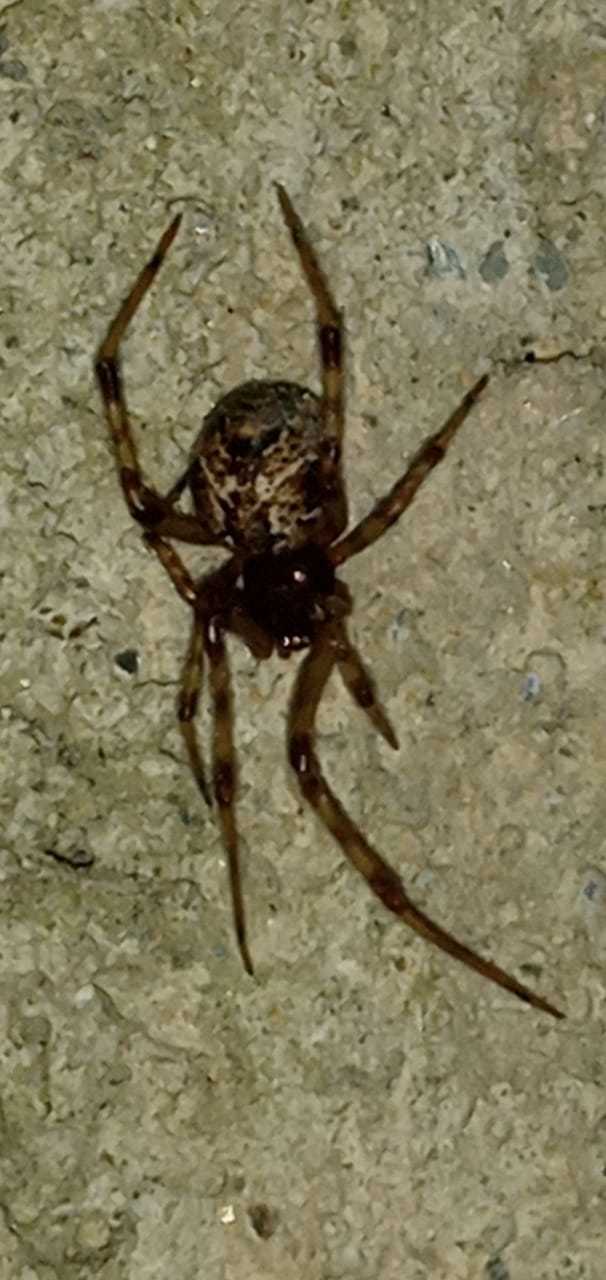
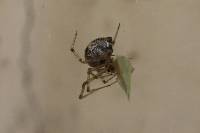
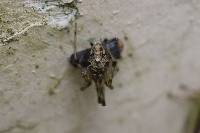
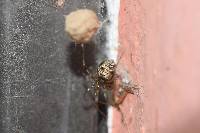
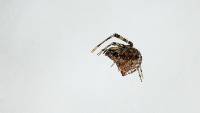
Parasteatoda tepidariorum, the common house spider or American house spider, is a spider species of the genus Parasteatoda with a cosmopolitan distribution. Common house spiders are synanthropic and live in and near human dwellings. Their prey mechanism is similar to that of the other cobweb spiders: the spider follows disturbances transmitted along the web to entangle and then paralyze its prey, which usually consists of household insects and other invertebrates (often considered as pests).
Distribution
Parasteatoda tepidariorum is native to Asia but has been introduced to Canada, the USA, South America, Europe, Morocco, Turkey, the Caucasus, Russia (Europe to Far East), Saint Helena, South Africa, the Seychelles, New Zealand, and Hawaii.
In South Africa, the species has been sampled from the provinces Gauteng, Eastern Cape, and Western Cape. Notable locations include Mountain Zebra National Park and Robben Island.
Habitat and ecology
This species constructs three-dimensional webs in dark corners and is frequently found around buildings.
In South Africa, Parasteatoda tepidariorum inhabits areas at altitudes from 1246 to 1513 m above sea level and has been sampled from the Fynbos, Nama Karoo, and Savanna biomes.
Description
1 Description
1.1 Appearance
1.2 Life cycle
1.3 Diet and predation
Common house spiders are variable in color from tan to nearly black, frequently with patterns of differing shades on their body. Females are generally between 5 and 6 millimetres (0.20 and 0.24 in) long, and males are generally between 3.8 and 4.7 millimetres (0.15 and 0.19 in) long. They can be an inch (2.5 cm) or more across with legs outspread. The average female body mass is about 37.7 mg. P. tepidariorum is similar in body shape to widow spiders. Males have a less bulbous abdomen than females. Common house spiders' size and coloration allow the spiders to blend into the background and escape notice.
This species can live for more than a year after reaching...