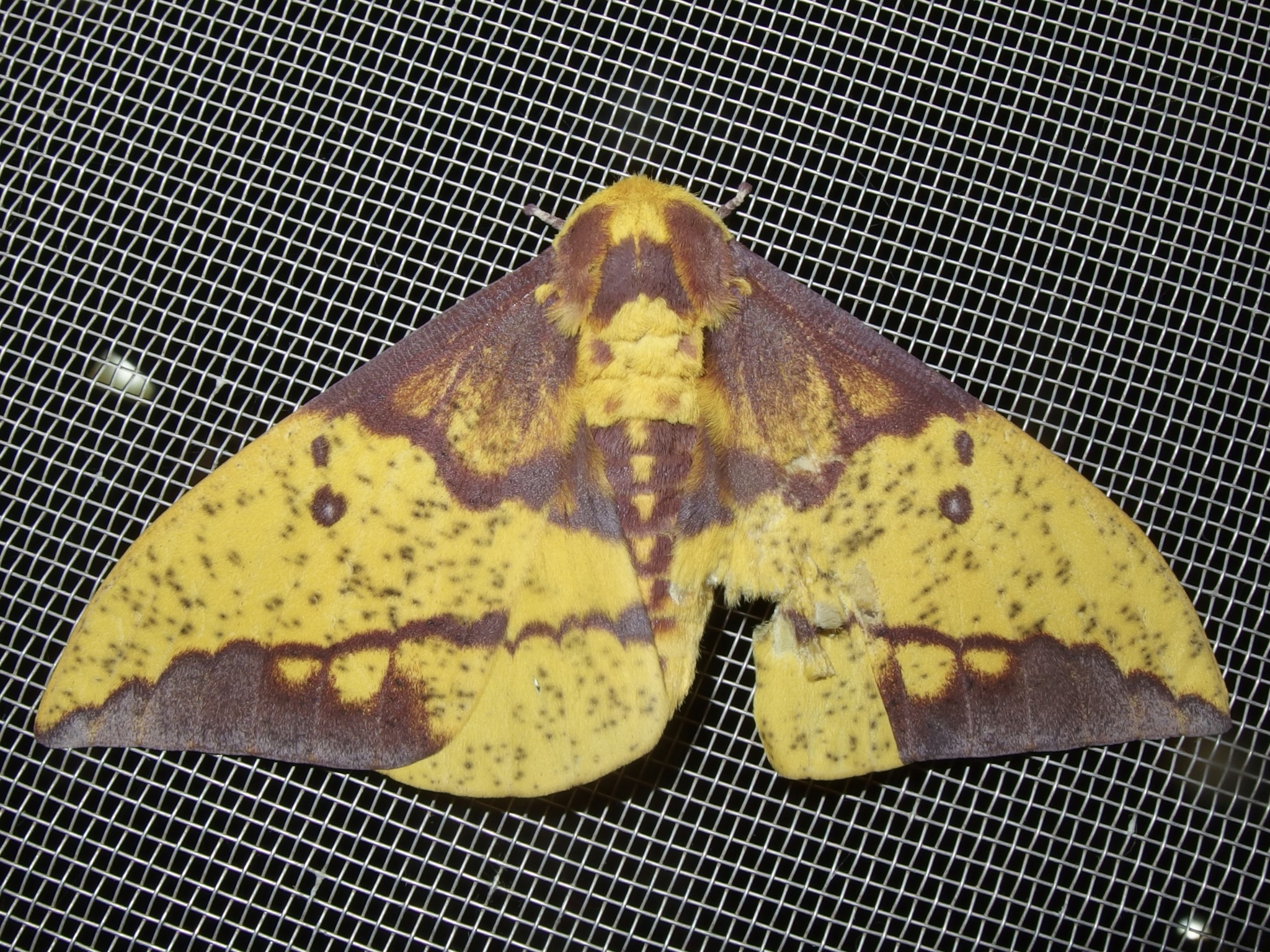
Eacles imperialis, the imperial moth, is a member of the family Saturniidae and subfamily Ceratocampinae. It is found mainly in the East of South America and North America, from the center of Argentina to south Canada. The species was first described by Dru Drury in 1773.
Description
Examples of Eacles imperialis variation
The imperial moth has evolved to look like rotting leaves. Here is a nearly identical poplar tree leaf.
The wingspan of an adult is between 80 and 175 mm (
Distribution
Imperial moths (their many regional morphs, subspecies, and sibling species) range from Argentina to Canada and from the Rocky Mountains to the Atlantic Coast. This species is the widest-ranging and northernmost in its genus Eacles. Nominate Eacles imperialis imperialis has been recorded historically from New England and southern Canada, south to the Florida Keys, and as far west as Nebraska. E. i. imperialis may not appear in Massachusetts today except for a population located on Martha's Vineyard. The true northern limits of the nominate's range are unknown because of possible confusion with subspecies E. i. pini in existing records. Subspecies E. i. pini occurs in coniferous and transition zone woodlands at the northern edges of the New England and Great Lakes States and northward into Canada. In the southwest, it is replaced by the closely related E. oslari. Other subspecies are found in Mexico and South America. Subspecies E. i. magnifica can be found in Brazil and surrounding regions.
Subspecies
The subspecies of Eacles imperialis:
E. i. imperialis (Drury, 1773)
E. i. pini (Michener, 1950)
E. i. cacicus (Boisduval, 1868)
E. i. hallawachsae (Brechlin & Meister, 2011)
E. i. quintanensis (Lemaire, 1971)
E. i. decoris (Rothschild, 1907)
E. i. tucumana (Rothschild, 1907)
E. i. opaca (Burmeister, 1878)
E. i. piurensis (Brechlin & Meister, 2011)
E. i. nobilis (Neumoegen, 1891)
E. i. magnifica (Walker, 1855)
E. i. anchicayensis (Lemaire, 1971)