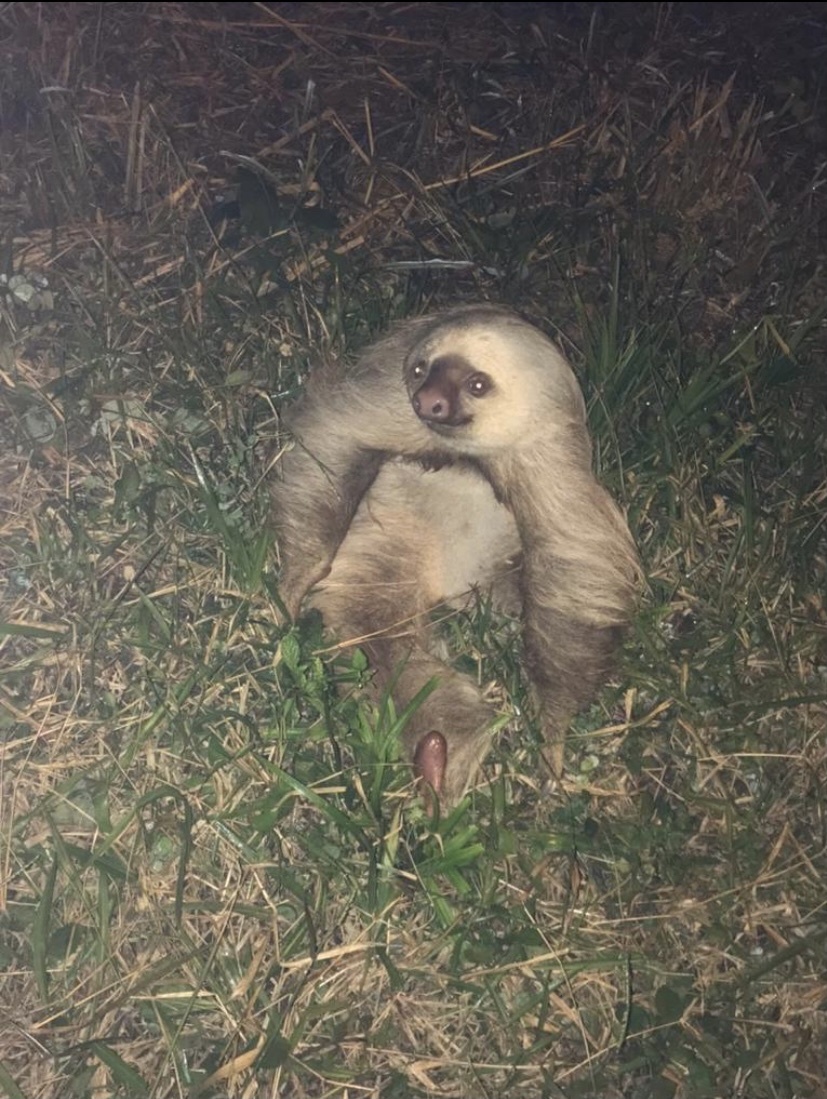
Choloepus is a genus of xenarthran mammals from Central and South America within the monotypic family Choloepodidae, consisting of two-toed sloths, sometimes also called two-fingered sloths. The two species of Choloepus (which means "lame foot" in Ancient Greek), Linnaeus's two-toed sloth (Choloepus didactylus) and Hoffmann's two-toed sloth (Choloepus hoffmanni), were formerly believed on the basis of morphological studies to be the only surviving members of the sloth family Megalonychidae, but have now been shown by molecular results to be closest to extinct ground sloths of the family Mylodontidae.
Extant species
Genus Choloepus – Illiger, 1811 – two species
Common name
Scientific name and subspecies
Range
Size and ecology
IUCN status and estimated population
Linnaeus's two-toed sloth
Choloepus didactylus (Linnaeus, 1758)
Northern South America, found in Venezuela, the Guyanas, Colombia, Ecuador, Peru, and Brazil north of the Amazon River
Size:
Five subspecies
C. h. hoffmanni, Peters, 1858 – Honduras, Nicaragua, Costa Rica, Panama
C. h. agustinus, Allen, 1913 – Venezuela, western Colombia, northern Ecuador
C. h. capitalis, Allen, 1913 – western Ecuador
C. h. juruanus, Lönnberg, 1942 – Brazil, Bolivia, extreme eastern Peru
C. h. pallescens, Lönnberg, 1928 – Peru
Central America and northwestern South America
Size: