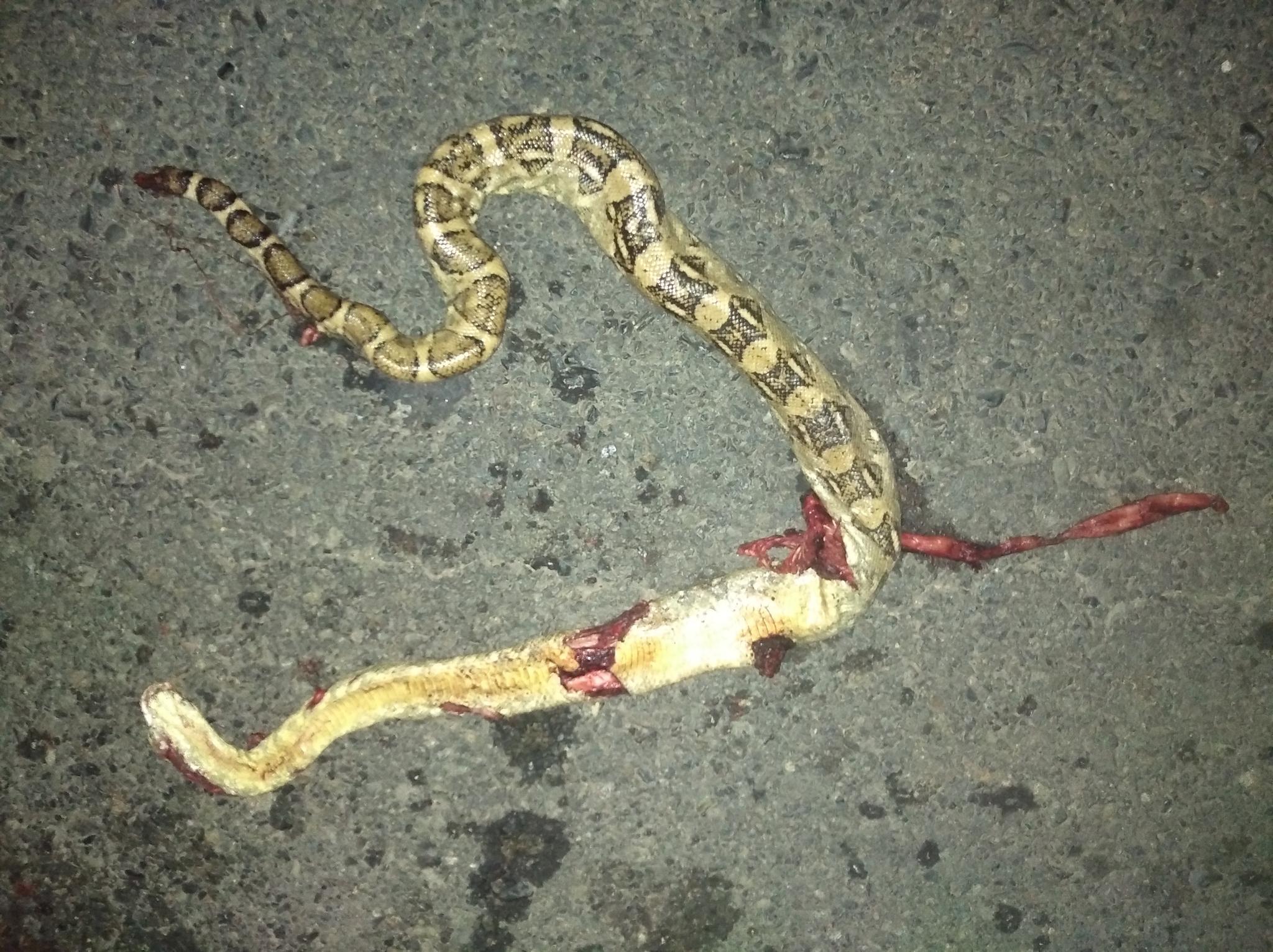
The Boidae, commonly known as boas or boids, are a family of nonvenomous snakes primarily found in the Americas, as well as Africa, Europe, Asia, and some Pacific islands. Boas include some of the world's largest snakes, with the green anaconda of South America being the heaviest and second-longest snake known; in general, adults are medium to large in size, with females usually larger than the males. Six subfamilies comprising 14-15 genera and 54-67 species are currently recognized.
Description
Like the pythons, boas have elongated supratemporal bones. The quadrate bones are also elongated, but not as much, while both are capable of moving freely so when they swing sideways to their maximum extent, the distance between the hinges of the lower jaw is greatly increased.
Cloaca region of a Boa constrictor with spurs (rudimentary hindlegs)
Both families share a number of primitive characteristics. Nearly all have a relatively rigid lower jaw with a coronoid element, as well as a vestigial pelvic girdle with hind limbs that are partially visible as a pair of spurs, one on either side of the vent. In males, these anal spurs are larger and more conspicuous than in females. A long row of palatal teeth is present, and most species have a functional left lung that can be up to 75% as large as the right lung.
Boids are, however, distinguished from the pythons in that none has postfrontal bones or premaxillary teeth, and that they give birth to live young. When labial pits are present, these are located between the scales as opposed to on them. Also, their geographical distributions are almost entirely mutually exclusive. In the few areas where they do coexist, the tendency is for them to occupy different habitats.
A fossil of Boavus idelmani, an extinct species of boa
Formerly, boas were said to be found in the New World and pythons in the Old World. While this is true of boine boas, other boid species are present in Africa, much of southern Eurasia,...