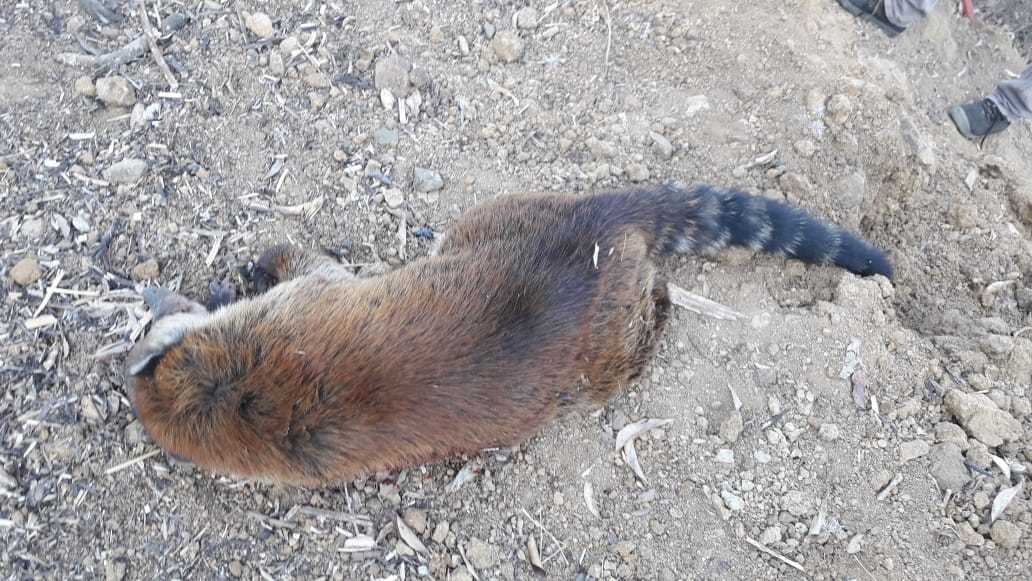
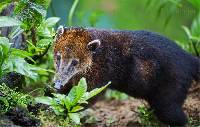
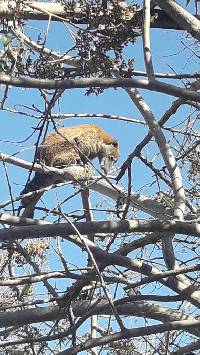
The South American coati (Nasua nasua), also known as the ring-tailed coati or brown-nosed coati, is a coati species and a member of the raccoon family (Procyonidae), found in the tropical and subtropical parts of South America. An adult generally weighs from 2–7.2 kg (4.4–15.9 lb) and is 85–113 cm (33–44 in) long, with half of that being its tail. Its color is highly variable and the rings on the tail may be only somewhat visible, but its most distinguishing characteristic is that it lacks the largely white snout (or "nose") of its northern relative, the white-nosed coati.
Distribution and habitat
Skull of a South American coati
The South American coati is widespread in tropical and subtropical South America. It occurs in the lowland forests east of the Andes as high as 2,500 m (8,200 ft) from Colombia and The Guianas south to Uruguay and northern Argentina. Nasua nasua occupancy is significantly and negatively related to elevation but positively related to forest cover.
It has been recorded in west Ecuador, and north and west Colombia. In Argentina, it has been recorded in Santa Fe and Salta Provinces. It has been introduced and naturalized on the island of Mallorca, where it is considered an invasive species.
The only documented records of white-nosed coati in South America are from far northwestern Colombia, in the Gulf of Urabá region, near the Colombian border with Panama. The smaller mountain coati lives foremost at altitudes above the South American coati, but there is considerable overlap.
Invasiveness
In the European Union, the South American coati has been included in the list of Invasive Alien Species of Union concern since 2016. This means that this species cannot be imported, bred, transported, commercialized, or intentionally released into the environment in the entire EU.
Its listing has been denied in the United Kingdom since late 2020, when the country left the membership act.
Behavior and ecology
South American coatis are variable in color and...