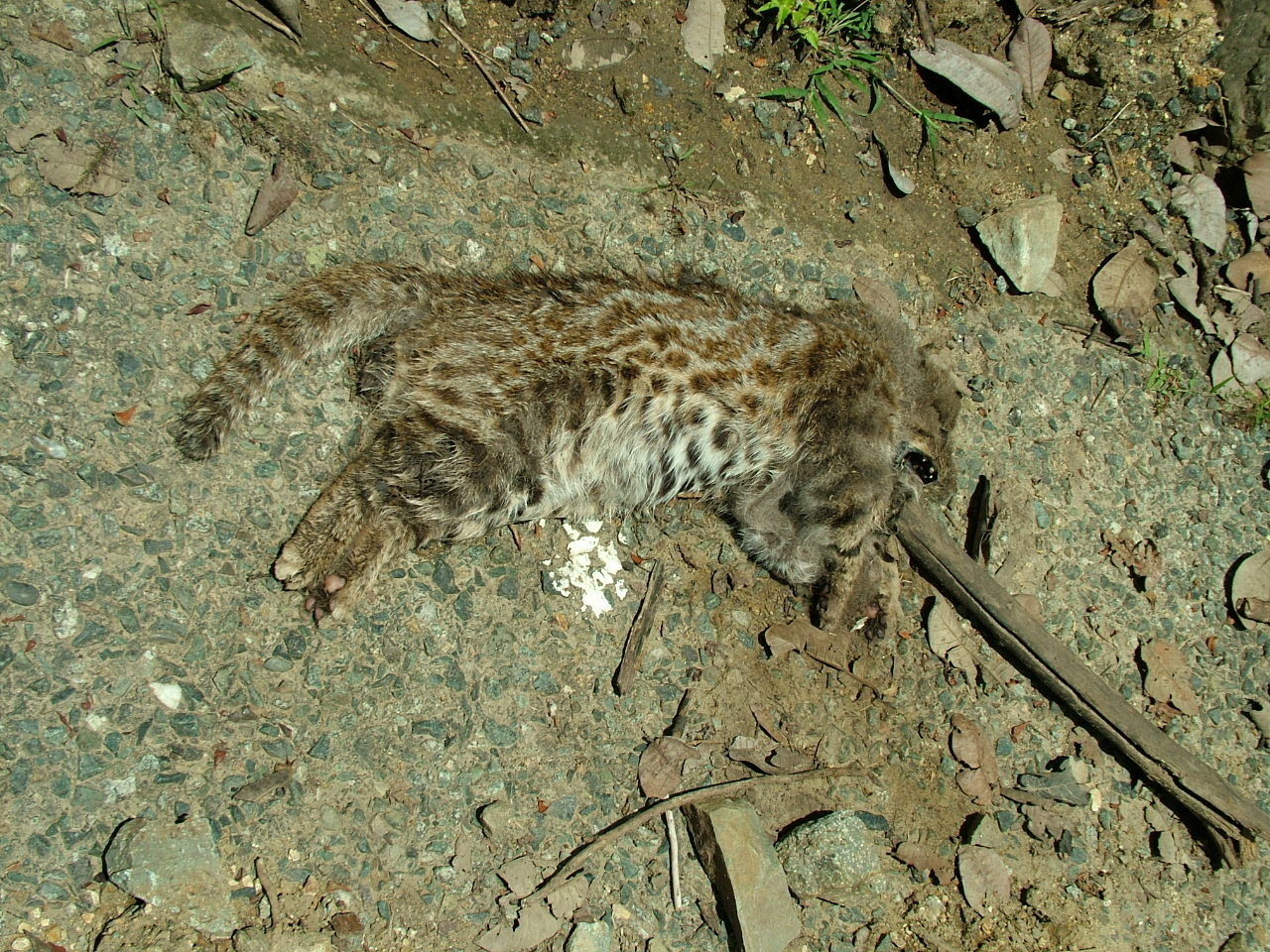
Leopardus is a genus of small cats native to the Americas. This genus is considered the oldest branch of a genetic lineage of small cats in the Americas whose common ancestor crossed the Bering land bridge from Asia to North America in the late Miocene.
Characteristics
Leopardus species have spotted fur, with ground colors ranging from pale buff, ochre, fulvous and tawny to light gray. Their small ears are rounded and white-spotted; their rhinarium is prominent and naked above, and their nostrils are widely separated. They have 36 chromosomes, whereas other felids have 38.
Taxonomy
The generic name Leopardus was proposed by John Edward Gray in 1842, when he described two spotted cat skins from Central America and two from India in the collection of the Natural History Museum, London.
Several genera were proposed in the 19th and early 20th centuries for small spotted cats in the Americas, including:
Dendrailurus, Lynchailurus, Noctifelis, Oncifelis and Oncoïdes by Nikolai Severtzov in 1858;
Margay, Pajeros, Pardalina and Pardalis by Gray in 1867;
Oncilla by Joel Asaph Allen in 1919;
Oreailurus by Ángel Cabrera in 1940;
Colocolo by Reginald Innes Pocock in 1941.
Analysis of skull morphology of these taxa revealed close similarities in their base of skulls and nasal bones, their masticatory muscles, and dentition.
Phylogenetic analysis of tissue samples of these taxa and their ability to hybridise support the notion that they are members of the same genus.
The following eight extant Leopardus species have been recognized as valid taxa by the IUCN since 2017:
Genus Leopardus – Gray, 1842 – eleven species
Common name
Scientific name and subspecies
Range
IUCN status and estimated population
Ocelot
Leopardus pardalis (Linnaeus, 1758)
Two subspecies
L. p. mitis (Cuvier, 1820)
L. p. pardalis (Linnaeus, 1758)
southwestern United States to northern Argentina
LC