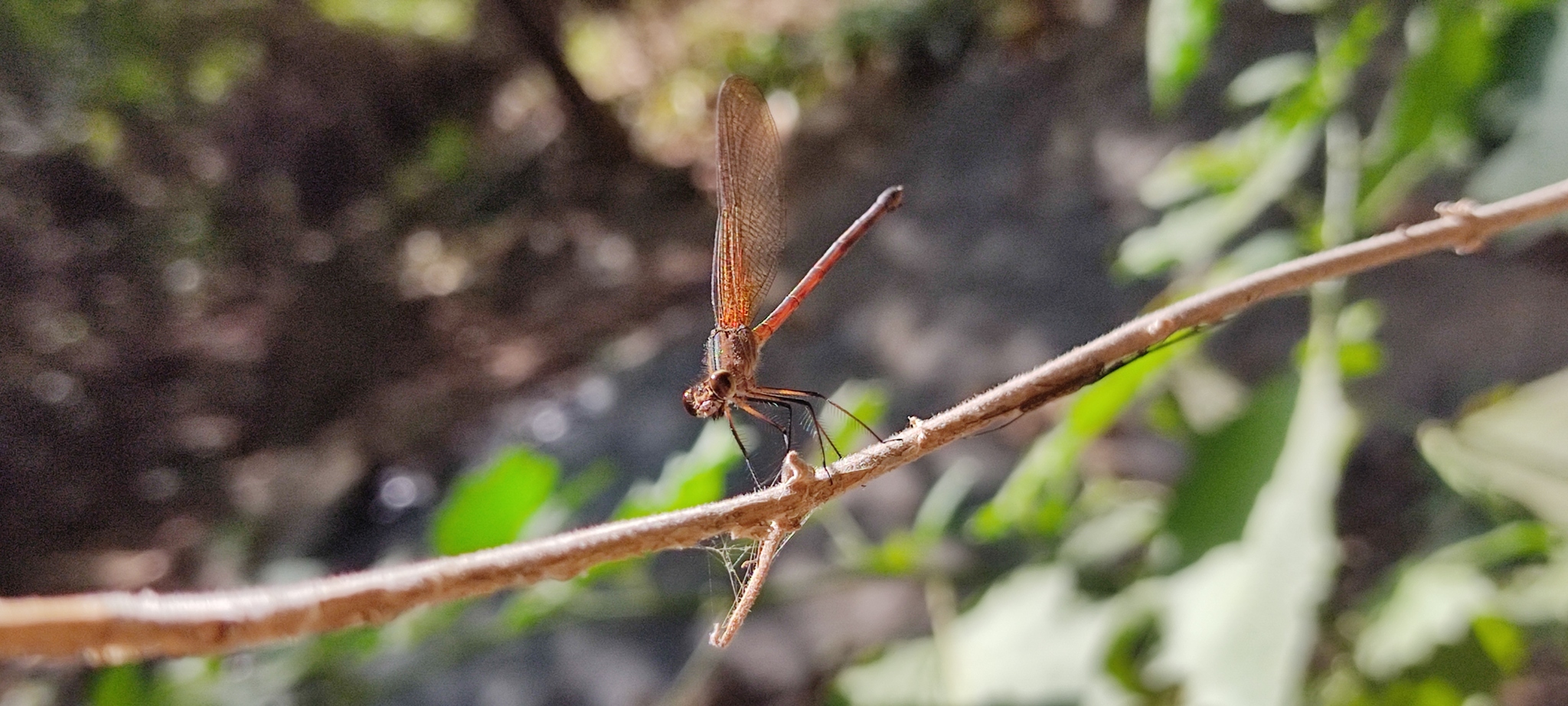
Calopterygidae is a family of damselflies, in the superfamily Calopterygoidea.
Members of Calopterygidae are commonly known as broad-winged damselflies, demoiselles, or jewelwings. These rather large damselflies have wingspans of 50–80 mm (compared to about 44 mm in the common bluetail damselfly, Ischnura elegans), are often metallic-coloured, and can be differentiated from other damselflies by the broader connection between the wings and the body, as opposed to the abrupt narrowing seen in other damselfly families. The family contains some 150 species.
The Calopterygidae are found on every continent except Antarctica. They live along rivers and streams.
Characteristics
The adults have metallic bodies; their wings are broader, with wider bases than other damselflies, and at rest hold their wings parallel to the body, slightly elevated. Some species have conspicuously colored wings; in males, the wings are usually blue, without pterostigmata, in females green or brown. Species are often quite variable in color and patterning, and they are sexually dimorphic. Color intensity may fade with age. The wings are heavily veined, having often 18 or more antenodal veins. The first segment of their antennae is longer than the combined length of the other segments. They have a jerky, skipping form of flight similar to the flight pattern of a butterfly (fluttering, rather than hovering stably like many other damselfly and dragonfly families). At least one species of Calopterygidae has shown morphological plasticity in wing length associated with the closeness of a forest to the river or stream where it lives, with a more distant forest correlating to greater wing length. Calopterygids perch horizontally on twigs near the water's edge.
Calopterygidae nymphs have lateral gills are longer than the median gills. The nymphs have a flattened, pentagonal-shaped head, a long first antennal segment and long legs. They are found among submerged aquatic plants, woody debris and the exposed...