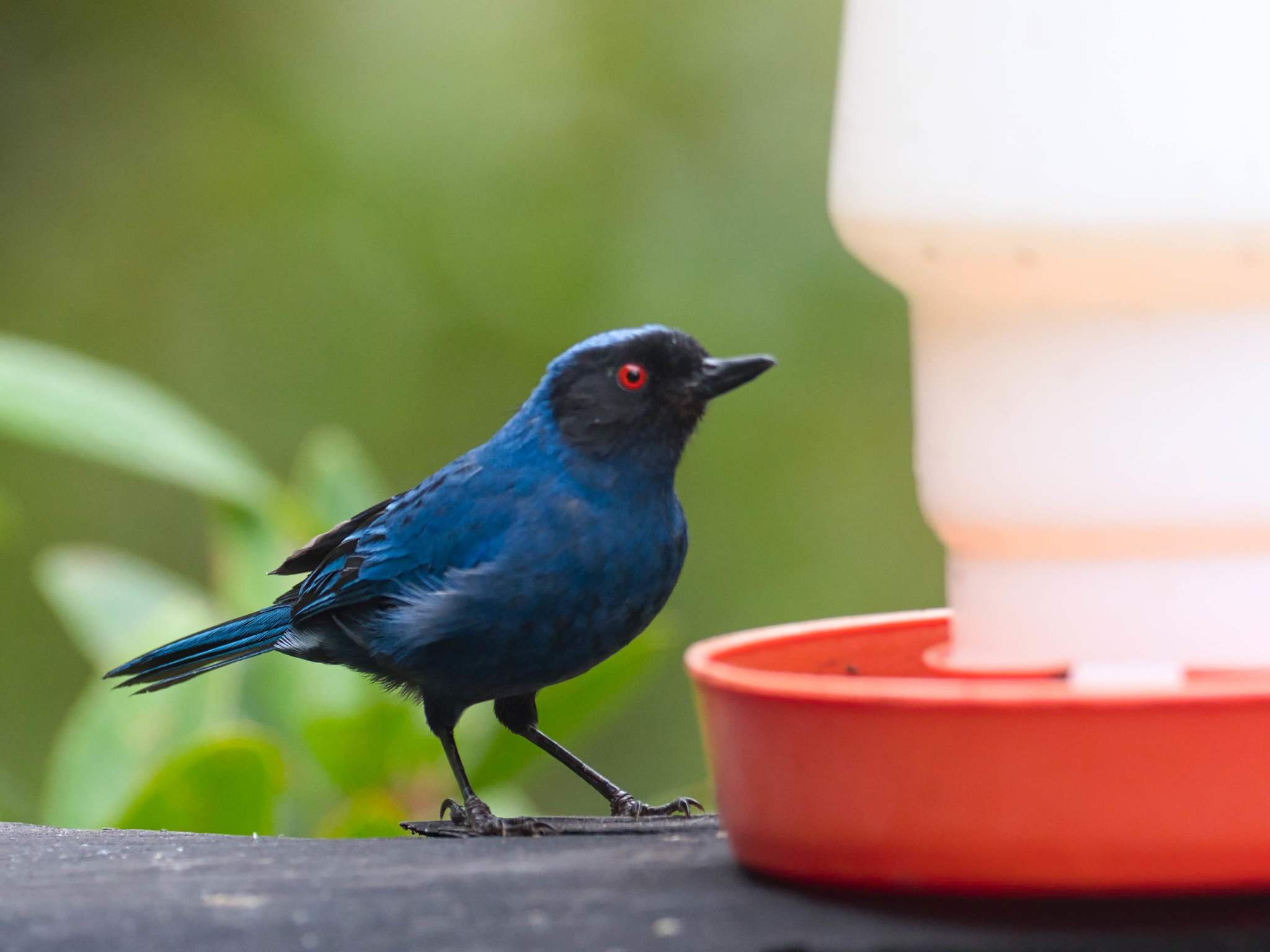
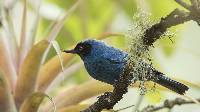
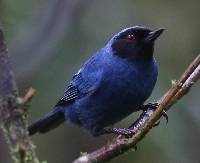
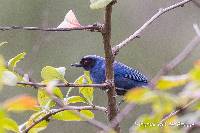
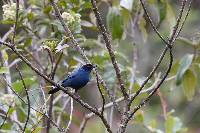
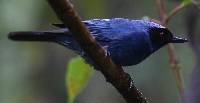
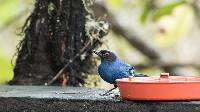
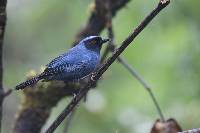
The warbling masked flowerpiercer or masked flowerpiercer (Diglossa cyanea) is a species of bird in the tanager family, Thraupidae. It is found in humid montane forest and scrub in Venezuela, Colombia, Ecuador and northern Peru. Flowerpiercers got their name from the fact that they have a sharp hook on the tip of their upper mandible which they use to slice open the base of flowers to get at the nectar. This species was formerly considered to be conspecific with the whistling masked flowerpiercer (Diglossa melanopis).
Taxonomy
The warbling masked flowerpiercer was formally described in 1840 by the French ornithologist Frédéric de Lafresnaye based on a specimen collected by Auguste Boissonneau near Santa Fe, Bogotá in Colombia. Lafresnaye coined the binomial name Uncirostrum cyaneum. The masked flowerpiercer is now one of 18 flowerpiercers placed in the genus Diglossa that was introduced in 1832 by the German naturalist Johann Georg Wagler.
Four subspecies are recognised:
D. c. obscura Phelps, WH & Phelps, WH Jr, 1952 – northwest Venezuela
D. c. tovarensis Zimmer, JT & Phelps, WH, 1952 – north Venezuela
D. c. cyanea (Lafresnaye, 1840) – west Venezuela, Colombia and Ecuador (except southwest)
D. c. dispar Zimmer, JT, 1942 – southwest Ecuador and northwest Peru
The whistling masked flowerpiercer (Diglossa melanopis) was formerly considered as a subspecies. It is now considered as a separate species based on the mitochondrial DNA divergence, vocalization and morphology.
Description
The warbling masked flowerpiercer grows to a length of about 15 cm (6 in). The adult male is deep ultramarine blue with a dark mask. The beak is large, black, and upturned, with a characteristic hook on the tip of the upper mandible. The iris is bright red. The female is similar in appearance but altogether duller. The juvenile has a reddish-brown iris. The song is a series of reedlike notes terminating in a twitter.