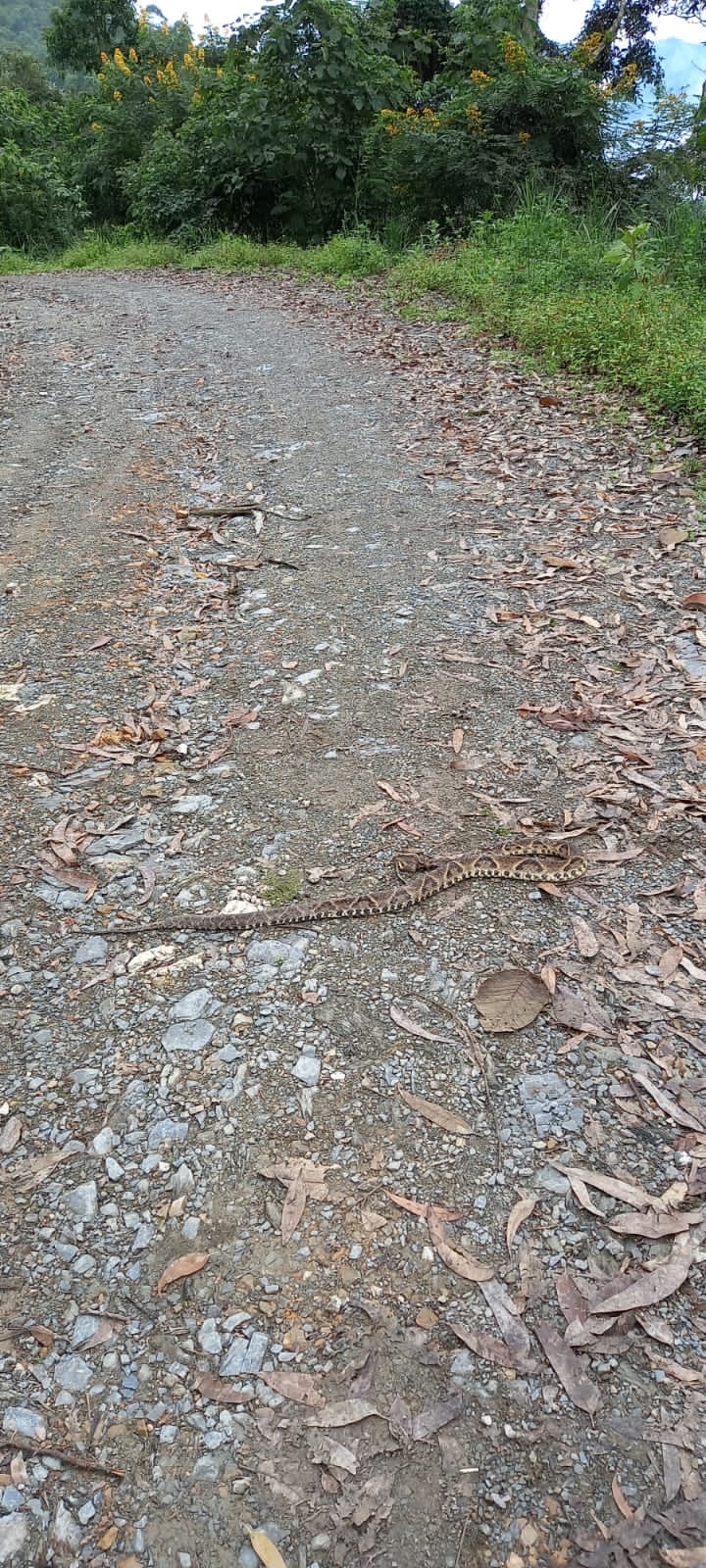
Bothrops is a genus of highly venomous pit vipers endemic to the Neotropics. The generic name, Bothrops, is derived from the Greek words βόθρος, bothros, meaning "pit", and ὄψ, ops, meaning "eye" or "face", together an allusion to the heat-sensitive loreal pit organs. Members of this genus are responsible for more human deaths in the Americas than any other group of venomous snakes. Currently, 48 species are recognized.
Description
Species in the genus Bothrops range in size from small, never growing to more than 50–70 cm (19.5–27.5 in), to large at over 200 cm (6.6 ft) in total length (tail included). Most are characterized by having a sharp canthus rostralis and an unelevated snout.
The arrangement of the scales on top of the head is extremely variable; the number of interorbital scales may be 3–14, with 7–9 supralabials and 9–11 sublabials. The snake has 21–29 rows of dorsal scales at midbody, 139–240 ventral scales, and 30–86 subcaudals, which are generally divided.
Common names
Lacépède originally applied the common name "lanceheads" to all snakes in the genus Bothrops, which he considered conspecific. Thus, older writings, as well as popular and sometimes scientific writings (including the American Heritage, Merriam-Webster, and New Shorter Oxford dictionaries), still often call them fer-de-lance (French, "spearhead"). However, many scientists and hobbyists now restrict this name to the Martinican species, B. lanceolatus. Other common names include American lanceheads and American lance-headed vipers.
Geographic range
Bothrops species are found in northeastern Mexico (Tamaulipas) southward through Central and South America to Argentina. They also occur on the islands of Saint Lucia and Martinique in the Lesser Antilles, as well as one species on Ilha da Queimada Grande off the coast of Brazil. B. atrox is also found on the island of Trinidad in the Caribbean off the eastern coast of Venezuela.