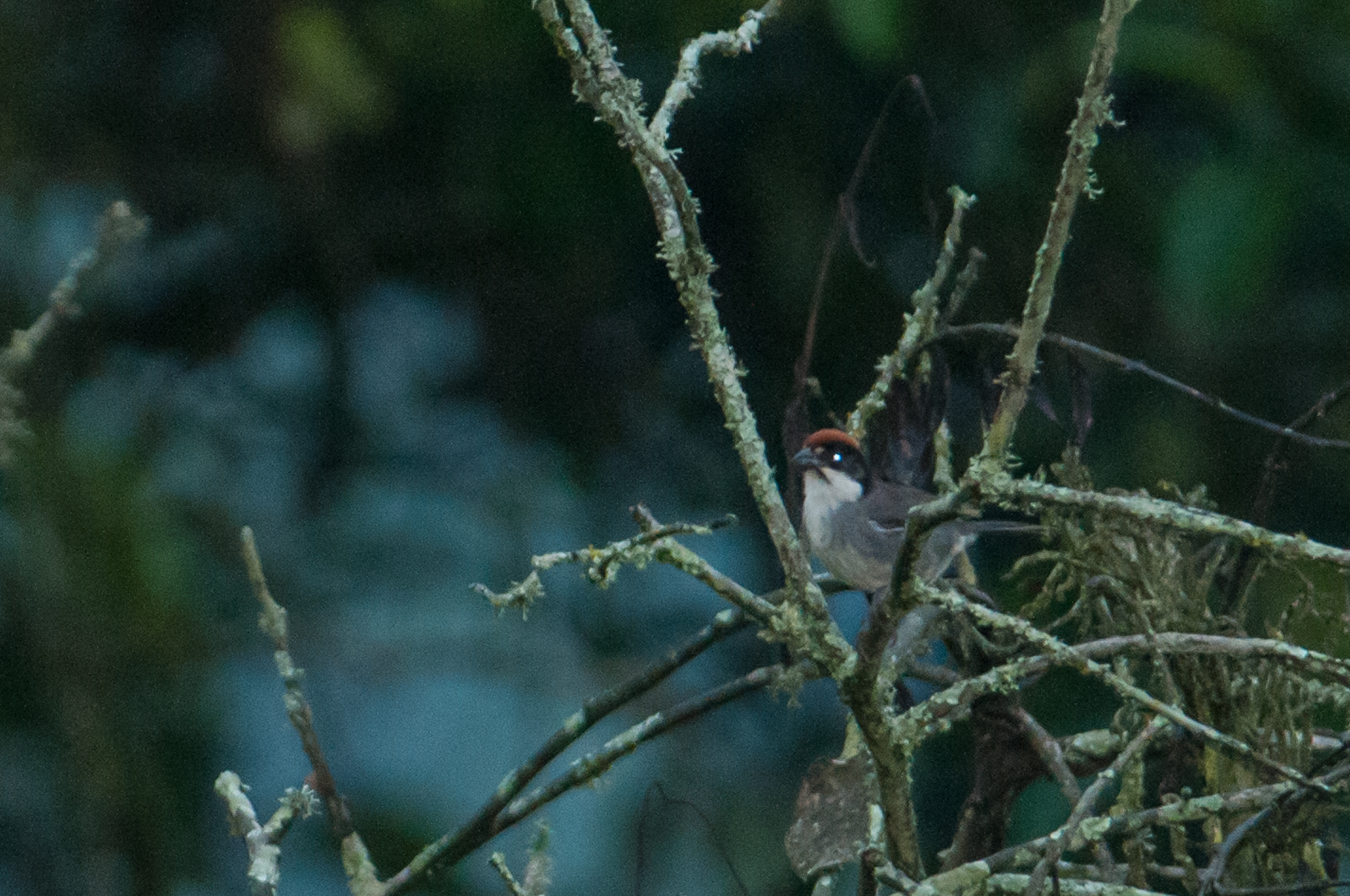
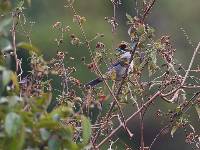
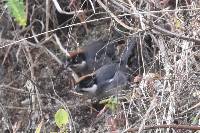
The bay-crowned brushfinch (Atlapetes seebohmi) is a species of bird in the family Passerellidae, the New World sparrows. It is found in Ecuador and Peru.
Taxonomy and systematics
The bay-crowned brushfinch was formally described in 1883 with the binomial Carenochrous seebohmi. The genus Carenochrous was later merged into the present Atlapetes. The specific epithet seebohmi honors Henry Seebohm. Various authors have treated the bay-crowned brushfinch as conspecific with one of the slaty brushfinch (A. schistaceus) or the rusty-bellied brushfinch (A. nationi).
The further taxonomy of the bay-crowned brushfinch is unsettled. The IOC and AviList assign it two subspecies, the nominate A. s. seebohmi (Taczanowski, 1883) and A. s. simonsi (Sharpe, 1900). However, the Clements taxonomy and BirdLife International's Handbook of the Birds of the World add a third subspecies, A. s. celicae (Chapman, 1925), that the other systems include within A. s. simonsi.
This article follows the two-subspecies model.
Description
The bay-crowned brushfinch is 16 to 17 cm (6.3 to 6.7 in) long. The sexes have the same plumage. Adults of the nominate subspecies have a black forehead and a deep rufous crown and nape. Their face is black with a wide white lower cheek and a thin black line below the front of it. Their upperparts are olive-gray; their wings and tail are slightly darker with white on the marginal coverts. Their chin and throat are white with a light gray breastband below them that extends along the flanks and is more olive-gray at the rear. The rest of their breast and their belly are whitish and their crissum buffy. Juveniles have browner upperparts than adults and buffy underparts with faint streaks. Subspecies A. s. simonsi has a rufous forehead, a white spot above the lores, and darker gray upperparts than the nominate. Both subspecies have a dark red-brown iris, a long, thick-based black bill, and grayish legs and feet.