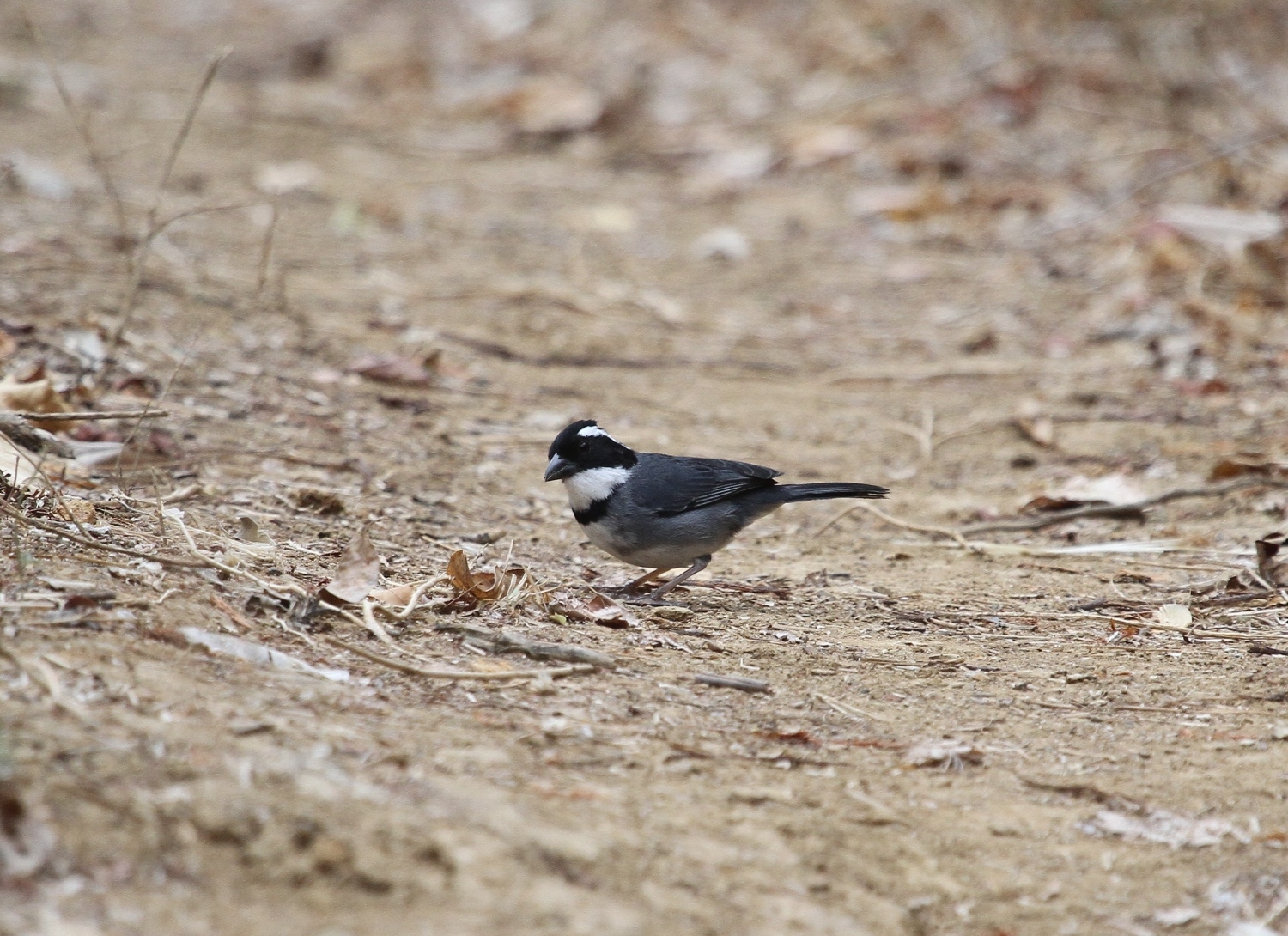
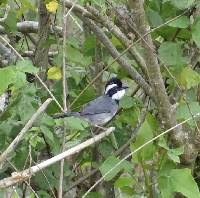
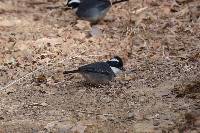
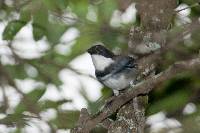
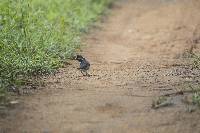
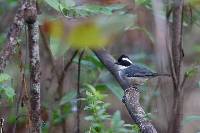
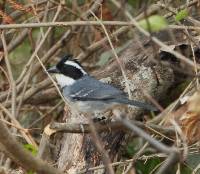
The black-capped sparrow (Arremon abeillei) is a species of bird in the family Passerellidae, the New World sparrows. It is found in Ecuador and Peru.
Taxonomy and systematics
The black-capped sparrow was formally described in 1844 with its current binomial Arremon abeillei.
The black-capped sparrow is monotypic. However, what is now the Maranon sparrow (A. nigriceps) was previously treated as a subspecies; taxonomic systems began separating them in 2016. A later study confirmed that the two are sister species.
Description
The black-capped sparrow is about 15 cm (5.9 in) long and weighs about 26 g (0.92 oz). The sexes have the same plumage. Adults have a mostly black head with a white throat and a wide white stripe from above the eye down the side of the nape. They often raise their crown feathers in a shaggy crest. Their upperparts and tail are blue-gray. Their wing coverts are blue-gray; some individuals have small pale tips on them that form two wing bars. Their flight feathers are dusky with blue-gray edges. Their throat is white with a black band below it across the upper breast. Their flanks are gray and the rest of their underparts white. They have a brown iris, a black bill, and black legs and feet.
Distribution and habitat
The black-capped sparrow is found along the Pacific coast from central Manabí Province in Ecuador south into Peru as far as northern Cajamarca Department. However, there is a gap in Ecuador's southern Guayas Province. It primarily inhabits somewhat dry tropical deciduous forest, gallery forest, and scrublands; locally it occurs in more humid evergreen forest especially in Ecuador. In Ecuador it ranges in elevation mostly from sea level to 800 m (2,600 ft) but locally reaches 1,600 m (5,200 ft). In Peru it reaches 1,800 m (5,900 ft).
Behavior
The black-capped sparrow is a year-round resident.
The black-capped sparrow's diet has not been studied; it is assumed to include insects, seeds, and fruits. It usually is seen...