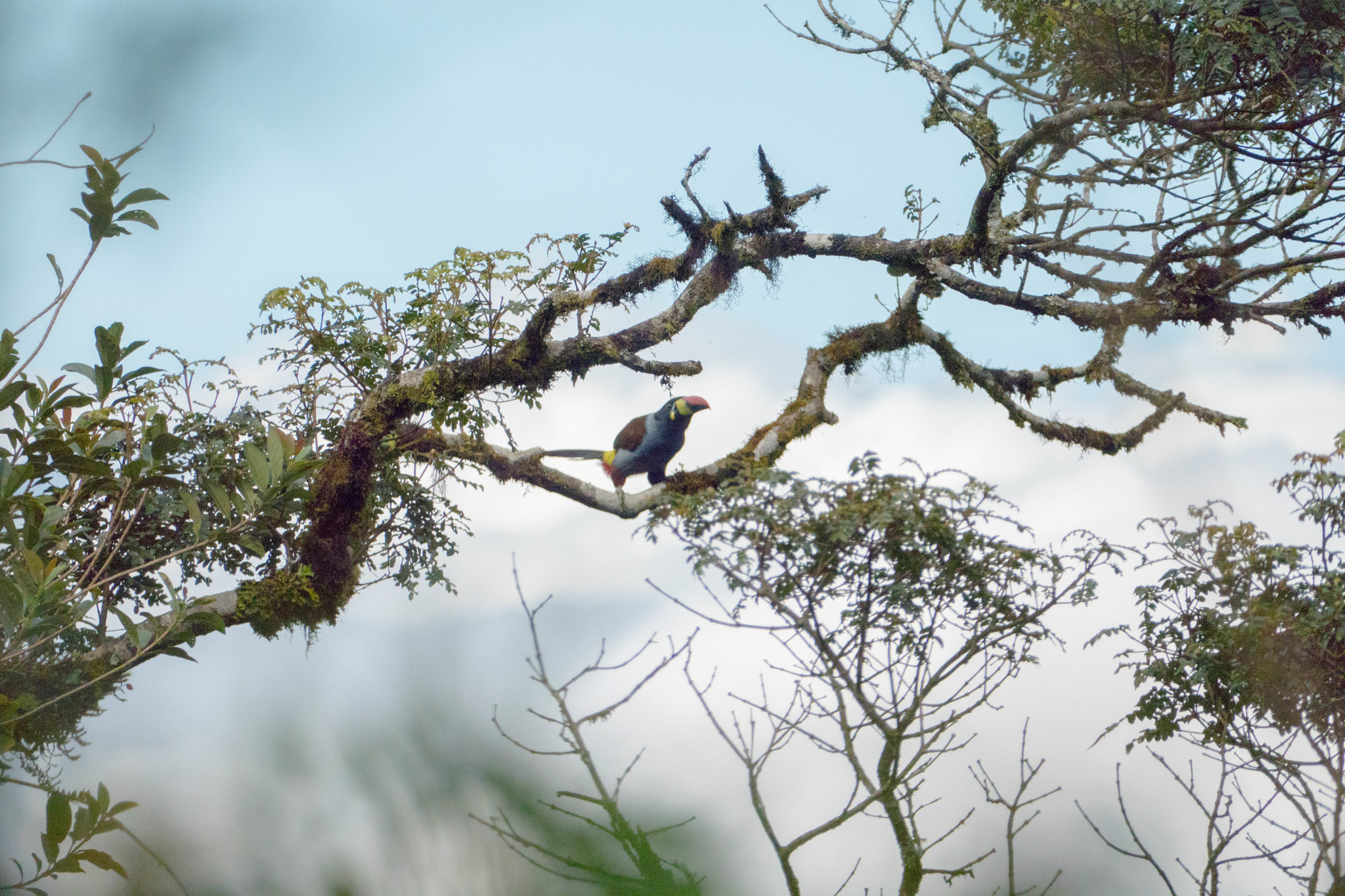
Toucans (, UK: ) are Neotropical birds in the family Ramphastidae. They are brightly marked and have large, often colorful bills. The family includes five genera and over 40 different species. Their closest relatives are the toucan-barbets.
Toucans are arboreal and typically lay two to four white eggs in their nests. They make their nests in tree hollows and holes excavated by other animals such as woodpeckers—the toucan bill has very limited use as an excavation tool. When the eggs hatch, the young emerge completely naked, without any down. Toucans are resident breeders and do not migrate. Toucans are usually found in pairs or small flocks. They sometimes fence with their bills and wrestle, which scientists hypothesize they do to establish dominance hierarchies. In Africa and Asia, hornbills occupy the same ecological niche as toucans, an example of convergent evolution.
Taxonomy and systematics
The name of this bird group is derived from the Tupi word tukana or the Guaraní word tukã, via Portuguese. The family includes toucans, aracaris and toucanets; more distant relatives include various families of barbets and woodpeckers in the suborder Pici.
The phylogenetic relationship between the toucans and the eight other families in the order Piciformes is shown in the cladogram below. The number of species in each family is taken from the list maintained by Frank Gill, Pamela C. Rasmussen and David Donsker on behalf of the International Ornithological Committee (IOC).