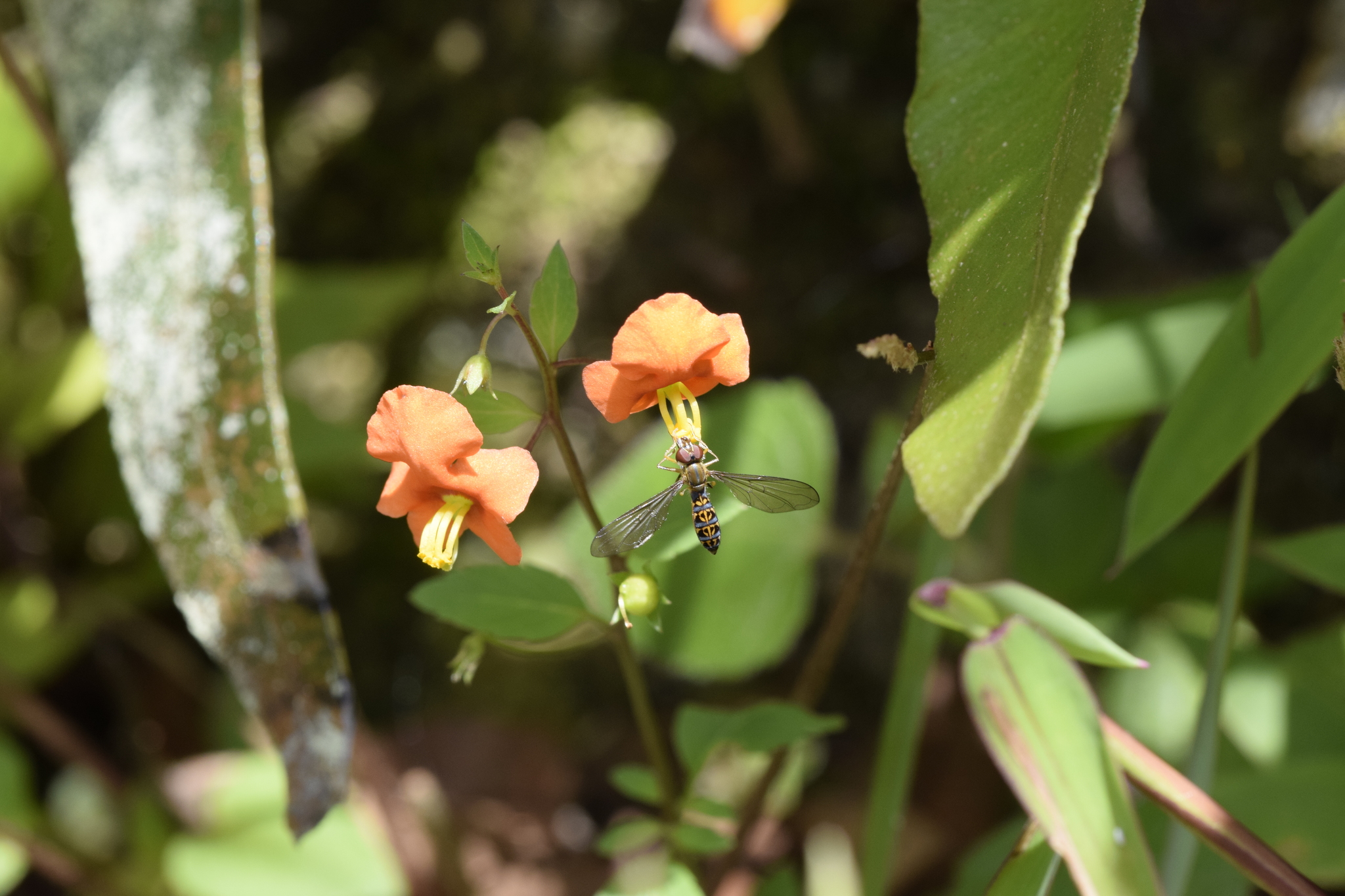
Toxomerus is a very large genus of hoverflies. They are found in many parts of North and South America.
Most larvae are predators on soft bodied insects, though a few species have been shown to feed on pollen. Adults feed on the pollen of a wide range of flowers.
Morphology
The majority of species are 6–9 mm in length.
A common trait of species within the genus is their mimicry of stinging Hymenoptera to avoid predators. What distinguishes Toxomerus from other hoverflies is the posterior indentation of their eyes and unique abdominal patterns; the abdominal patterns are diagnostic at the species level within the genus. Eyes are large (taking up approximately 2/3 of head) and range from red to black in color. Males and females can be distinguished by the dorsal spacing of their eyes, with males having a narrow gap and females having more space showing their ocelli.
Classification and distribution
Both molecular and morphological analysis have been used to establish Toxomerus monophyly. Not all of Toxomerus species have been described, though over 130 Neotropical species and 6 endemic Nearctic species are known. Some species have been discovered in the Old World in the afrotropics and are assumed to have been introduced due to their high genetic similarity to South American species. Toxomerus species are the most abundant hoverflies (or syrphid flies) in the Americas. Toxomerus marginatus is the most ubiquitous species in the North and is polyvoltine, brooding multiple times per year. Toxomerus dispar is the most common in the tropics, though T. pulchellus is more common in some areas.
Biology and ecology
Although they are high fidelity hymenopteran mimics they do not engage in behavioral mimicking such as leg waving, wing wagging, and mock-stinging. They also have significantly less hair than bees. As in all flies, Toxomerus species have 4 life stages: egg, larva, pupa, adult. The lifespan of the average adult is about a month and can vary depending on the season with shorter spans in the summer and...