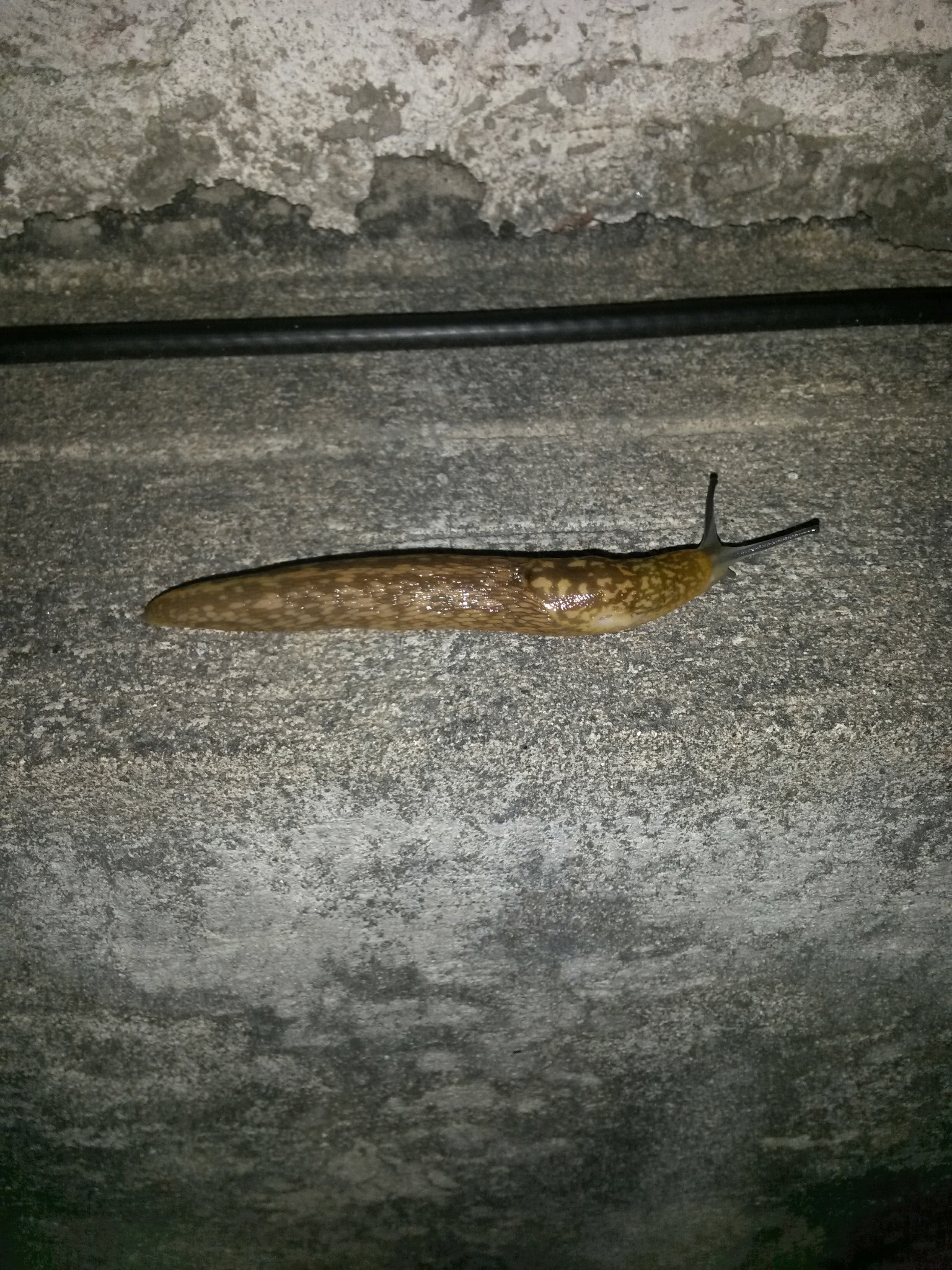
Limacus flavus, known commonly as the cellar slug, the yellow slug, or the tawny garden slug, is a large species of air-breathing land slug, a terrestrial pulmonate gastropod mollusc in the family Limacidae.
Description and identification
Genitalia of the two Limacus species; bc = bursa copulatrix, p = penis, ovi = free oviduct
Limacus flavus and L. maculatus are both large species of slug (up to 130 mm) with a yellow colouration, mottled with darker blotches; the tentacles are blue-grey. Juveniles are much darker. Like other limacid slugs, the tail is pointed and the pneumostome lies in the hind part of the mantle. The mucus is yellow or colourless.
The most reliable character to distinguish L. flavus from L. maculatus is where the duct of the bursa copulatrix attaches. It attaches to the base of the penis or to the atrium in L. maculatus, but some distance along the free oviduct in L. flavus.
External characters proposed to distinguish the species appear to be less consistent but may be useful in particular regions or as a preliminary indication. For instance in the British Isles L. flavus differs from L. maculatus in having a pale line along the midline of the back, but this is not consistenly present in Ukrainian populations. Claims that the dark pigment extends further ventrally down the flanks in L. maculatus are contradicted by British and Dutch specimens.
In the British Isles, apparently hybridisation has given rise to individuals with the genital characters of L. flavus but the mitochondrial DNA sequences of L. maculatus.
Drawing of reproductive system of Limacus flavus.
Distribution
Limacus flavus is most likely to be native in some area around the Mediterranean but has evidently been spread by man much more widely, so a genetic analysis would be necessary to be more certain of its origin. It has long occurred throughout most of Europe (certainly in Britain in the 17th century), but in central and northern parts it is usually associated with cellars and drains....