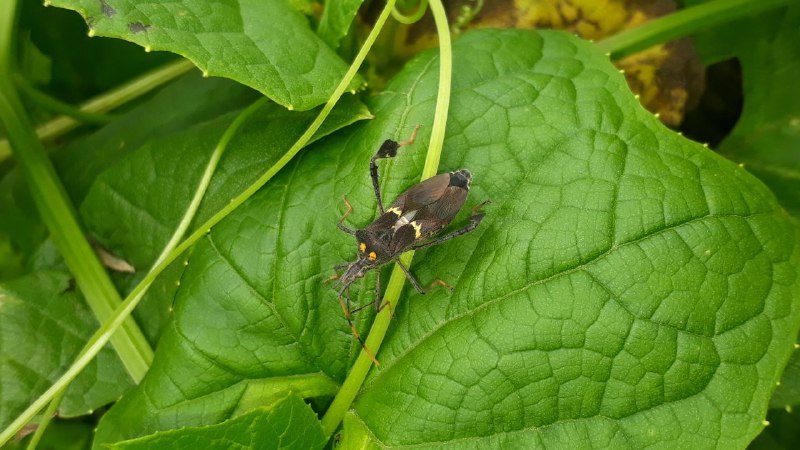
Leptoglossus is a genus of true bugs in the leaf-footed bug family and the tribe Anisoscelini. Species are distributed throughout the Americas, with some records in eastern & southern Asia and Europe (mostly introductions).Like members of some other genera in the family, these bugs have leaflike dilations of the hind tibia.
Behavior
Species Leptoglossus australis engage in sexual dimorphism by the functional morphology of their femurs. Members of L. australis sexes vary based on length, width, and number of spines on their femur. In males, it is most common for the widest part of their femur to be located at the third spine, while in females the widest part of their femur is commonly located at the third spine.
Variation of L. australis additionally lies in the length of the femur, where the males have a larger femoral length compared to the females. The enlarged femur in males is used as a weapon in male contests as a form of courtship.
Species Leptoglossus phyllopus engages in sexual dimorphism using a ventral abdominal gland only found in sexually mature males. This gland would excrete a yellow-brown fluid when extended and is only present in sexually active males, which will eventually be lost when the male is no longer sexually active.
Species Leptoglossus zonatus and Leptoglossus phyllopus engage in symbiotic relationships with the pathogenic bacteria, Burkholderia. Species with have the symbiotic bacteria experienced a higher fitness and were larger compared to species without the symbiont. Burkholderia is not transmitted through reproduction, so offspring of Leptoglossus must find and consume the bacteria. This is done by ingesting soil containing Burkholderia, where the symbiont will colonize in the midgut region. Despite the advantage Burkholderia provides to Leptoglossus, it is currently unknown what the bacteria provides to cause this increase in fitness.
Species Leptoglossus occidentalis is famous for feeding coniferous tree...