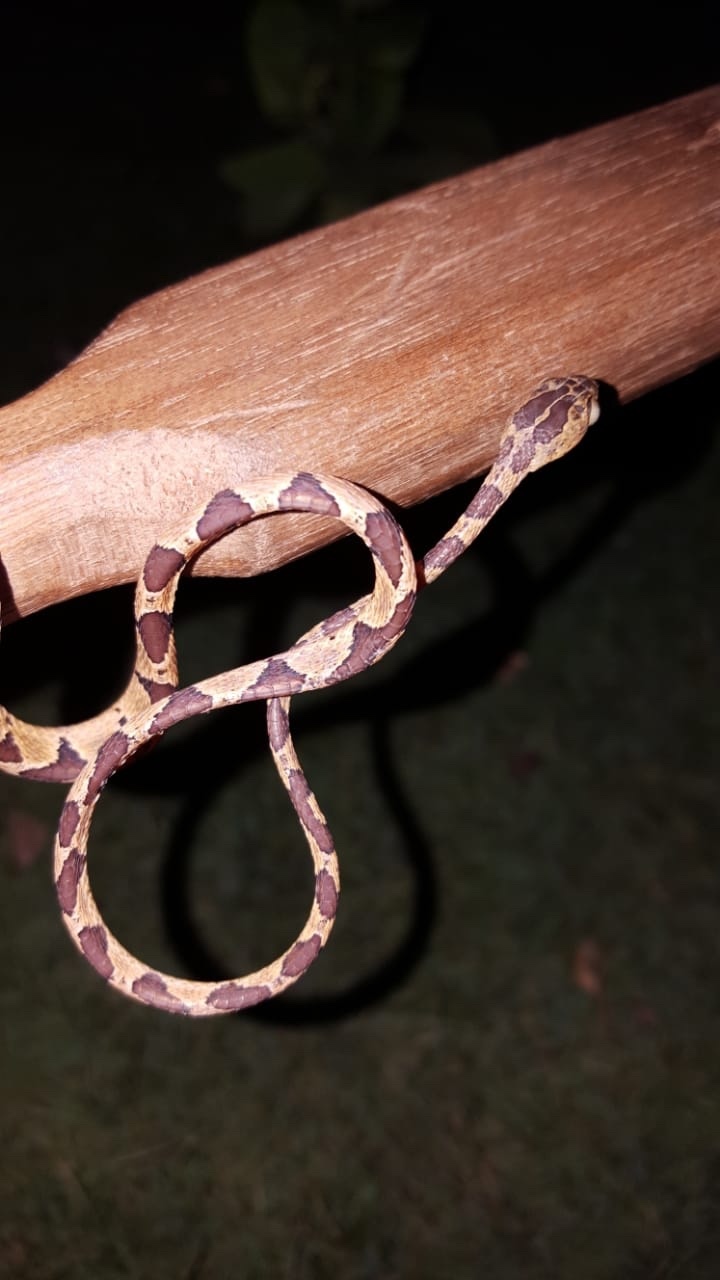
Imantodes cenchoa, also known commonly as the blunthead tree snake, the neotropical blunt-headed tree snake, and the fiddle-string snake, is a species of mildly venomous, rear-fanged snake in the family Colubridae. The species is native to Mexico, Central America, and South America.
Description
The blunthead tree snake averages about 800 mm (31 in) in total length (including tail). Maximum total length is about 1.5 m (4 ft 11 in).
I. cenchoa is known for its long, slender body and very large head. The pupil of its eye is very distinct from other snakes. Most snakes found around the world are known to have very poor vision and rely mostly on smell and vibrations to detect signs of prey and predators. Arboreal snakes have much better vision than other snakes. The blunthead tree snake has a vertical slit for a pupil which allows the snake to look downward. This trait gives the blunthead tree snake an advantage over other snakes. The large eyes make up approximately 26% of its head.
The ventral surface, or stomach, of the blunthead tree snake is mostly white, while the dorsal surface, or top, is a light or pale brown with lateral dark brown patches that begin at the head and continue down the length of the body. The northern and southern populations of the blunthead tree snake exhibit different sexual dimorphism, the existence of two different traits of a species in the same population. For example, northern males have a slightly longer tail whereas the males of southern populations have a shorter tail. In some regions females typically have a much larger head than males.
Habitat
The blunthead tree snake is arboreal. It is most often found in low vegetation such as coffee trees or bromeliads. It prefers cooler and moist areas such as wet forests and rainforests. It is found at altitudes from sea level to 1,700 m (5,600 ft).
Geographic range
I. cenchoa is found in Mexico, most of Central America, and parts of South America south to northernmost...