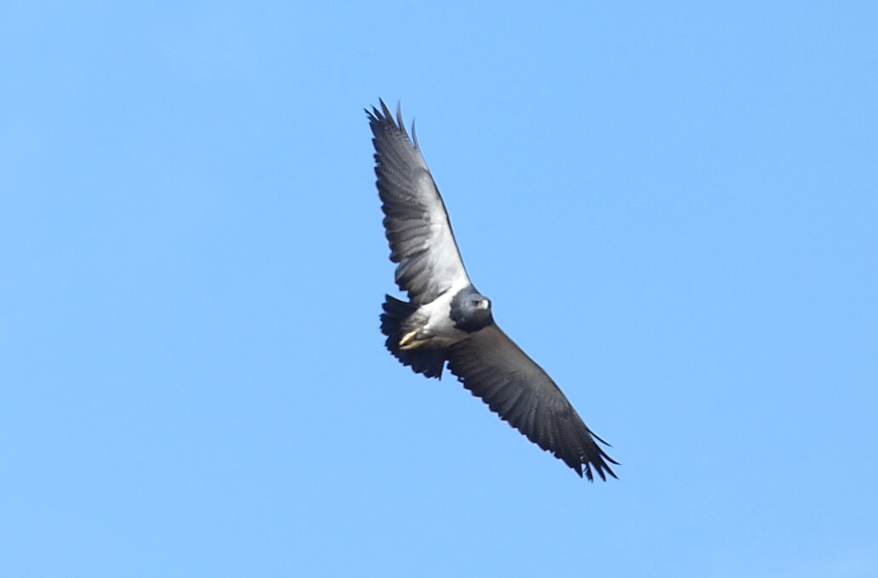
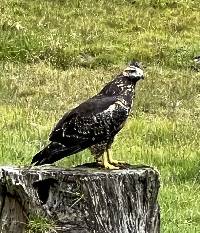
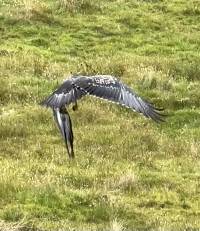
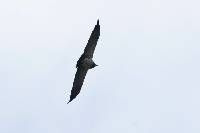
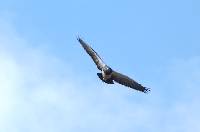
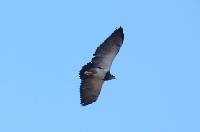
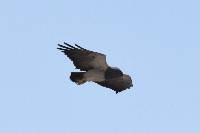
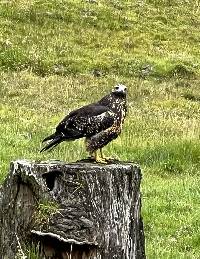
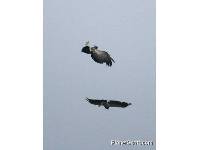
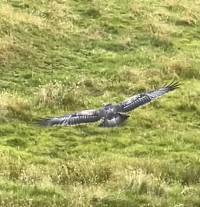
The black-chested buzzard-eagle (Geranoaetus melanoleucus) is a bird of prey of the hawk and eagle family (Accipitridae). It lives in open regions of South America. This species is also known as the black buzzard-eagle, the gray buzzard-eagle, or analogously with "eagle" or "eagle-buzzard" replacing "buzzard-eagle", or as the Chilean blue eagle. It is sometimes placed in the genus Buteo.
Taxonomy and systematics
Its scientific name is Latinized Ancient Greek and means "black-and-white crane-eagle" or (if called Buteo melanoleucos) "black-and-white buzzard": Geranoaetus comes from Ancient Greek géranos (γέρανoς), "crane" + aetós (ἆετός), "eagle". The "crane" reference is due to its grey upper wings and its loud cries. The alternative genus name Buteo is simply the Latin term used for these hawks in Ancient Rome, translating as "buzzard" (in the European sense). melanoleucus is from Ancient Greek mélan- (μέλαν-), "black-" + leukós (λευκός), "white". This refers to the contrasting coloration when seen from below.
When the black-chested buzzard-eagle was first described by Louis Pierre Vieillot in 1819, it was placed in the genus Spizaetus, as Spizaetus melanoleucus. Nowadays, however, the monotypic genus Spizastur is merged in Spizaetus, and the black-and-white hawk-eagle, originally described as by Vieillot three years earlier as Buteo melanoleucus, is now known as Spizaetus melanoleucus. The earlier use of the specific epithet melanoleucus for the black-and-white hawk-eagle technically precludes its use for the black-chested buzzard-eagle, except when it is placed in Geranoaetus. In fact, in the mid-20th century Buteo fuscescens was the prevailing name for the black-chested buzzard-eagle for some years, but it was eventually dismissed as erroneous. This specific name was established – as Spizaetus fuscescens – by Vieillot for the immature of the black-chested buzzard-eagle at the very same time as he described the adult because he could not believe...