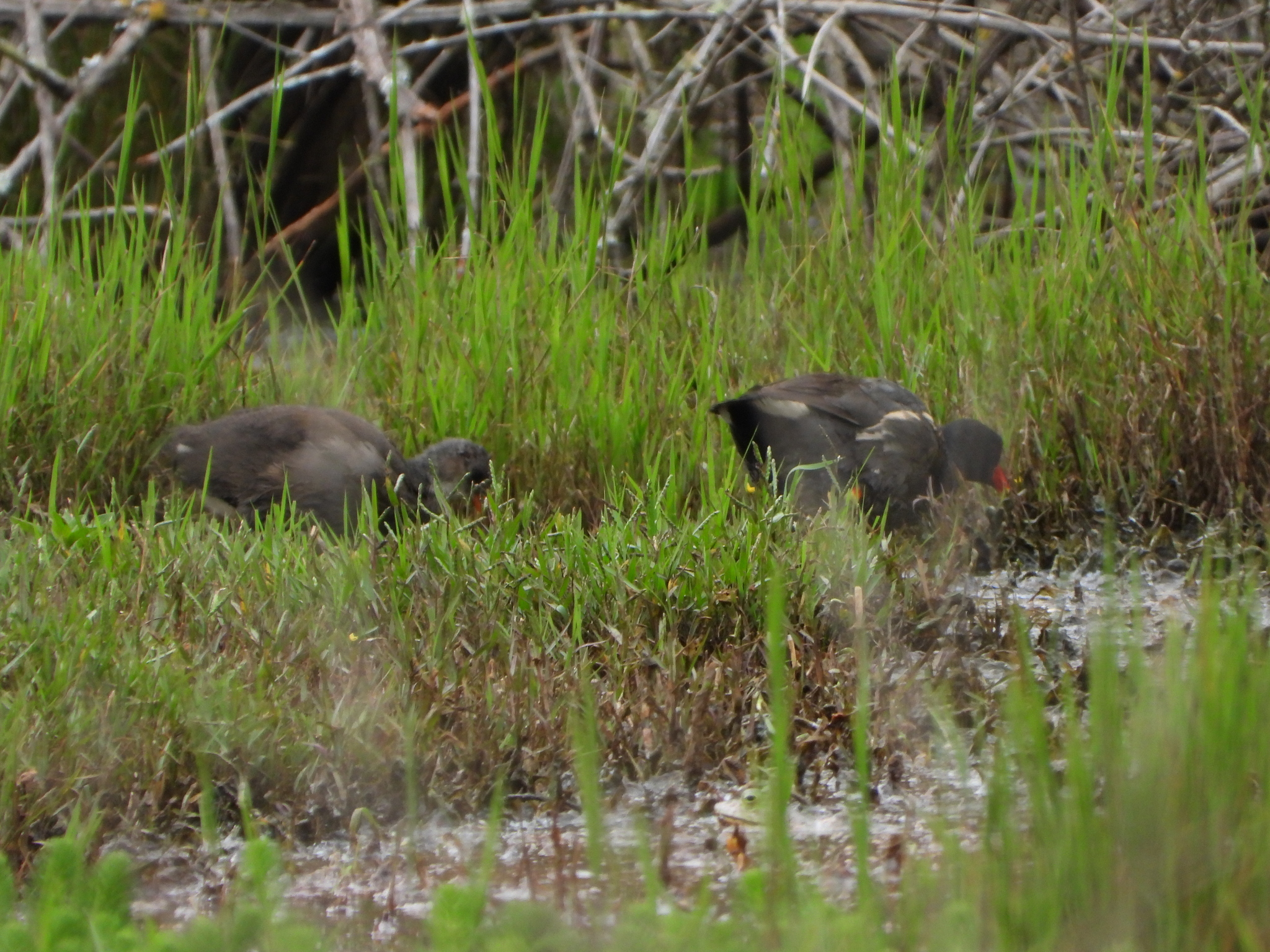
Moorhens are medium-sized water birds in the genus Gallinula, Latin for 'little hen', in the rail family Rallidae. The genus currently includes seven species, of which one is extinct, and two others probably are. Three species formerly included in Gallinula have been found to have enough differences to be placed in two separate but closely related genera, Paragallinula (with one species, lesser moorhen Paragallinula angulata), and Tribonyx, the two native hens of Australia; Tribonyx differs visually by shorter, thicker and stubbier toes and bills, and longer tails that lack the white signal pattern of typical moorhens. The moorhens are also close relatives of the coots (Fulica), but the swamphens (Porphyrio), formerly also thought to be close relatives, are now known to be less closely related.
Description
Common moorhens fighting
These rails are dumpy, compact birds with mostly brown and black with some white markings in their plumage; they range from 25 to 40 cm long. The bills are red, mostly with a yellow tip, and the legs are yellowish-green to yellowish-orange; the toes are long, but not webbed, nor lobed as in coots. Unlike many of the rails, they are usually easy to see because they feed in open water margins rather than hidden in reedbeds.
They have short rounded wings and are weak fliers, although usually capable of covering long distances. The common moorhen in particular migrates up to 2,000 km (1,200 mi) from some of its breeding areas in the colder parts of Siberia. Those that migrate do so at night. The Gough moorhen is almost flightless, and can fly only short distances. Loss of flight appears to have evolved independently in the moorhens of Gough and Tristan da Cunha, illustrating the repeated evolution of flightlessness among insular gallinules. More broadly, flightlessness has evolved repeatedly in island-dwelling rails, with the Rallidae showing a particular propensity for this form of evolution.