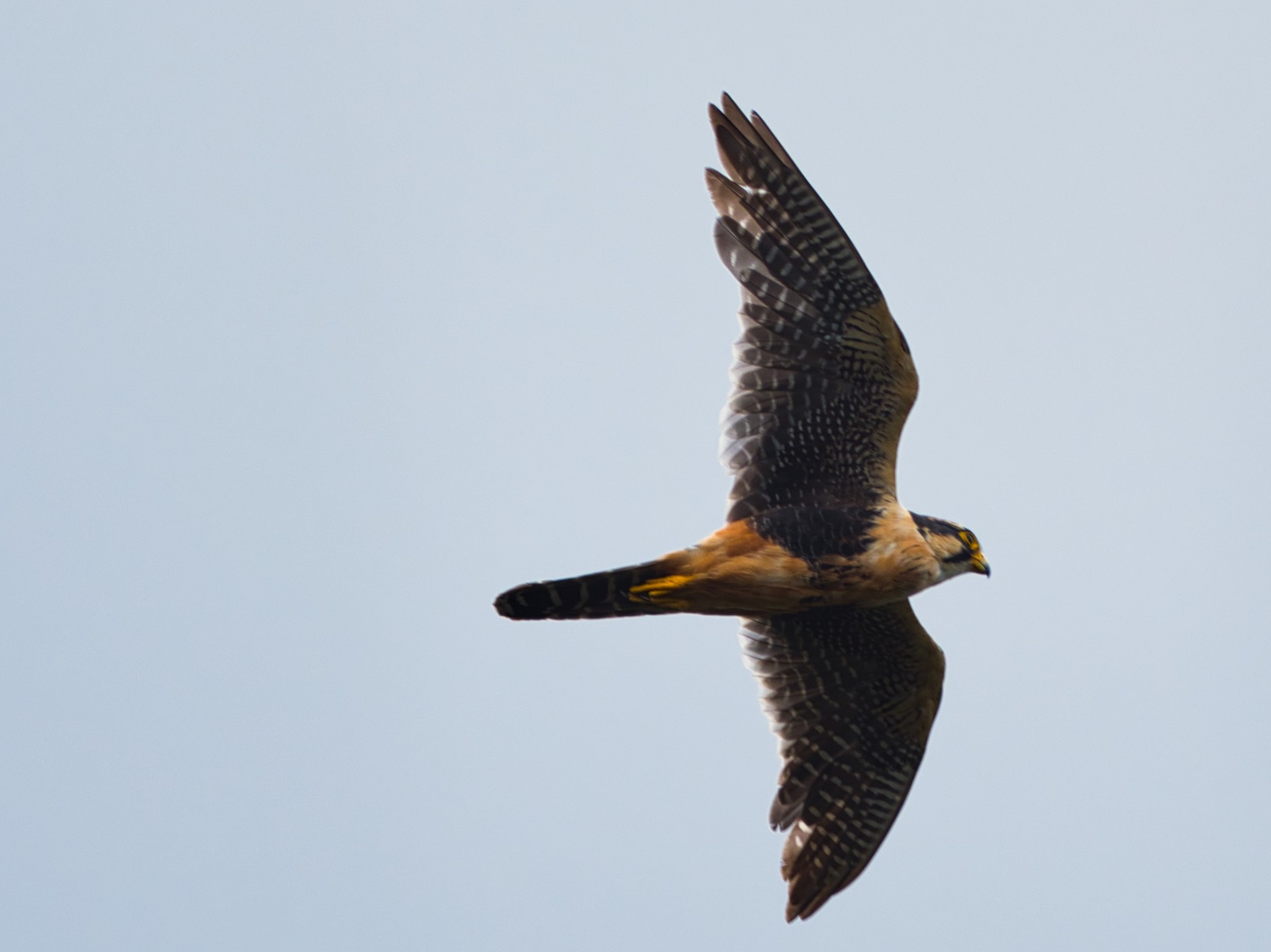
The aplomado falcon (Falco femoralis) is a medium-sized falcon of the Americas. The species' largest continuous range is in South America, but not in the deep interior Amazon Basin. It was long known as Falco fusco-coerulescens or Falco fuscocaerulescens, but these names are now believed to refer to the bat falcon (F. rufigularis). Its resemblance in shape to the hobbies accounts for its old name orange-chested hobby. Aplomado is an unusual Spanish word for "lead-colored", referring to the blue-grey areas of the plumage; an approximate English translation would be "plumbeous falcon". Spanish names for the species include halcón aplomado and halcón fajado (roughly "banded falcon", in reference to the characteristic pattern); in Brazil it is known as falcão-de-coleira (roughly "collared falcon", in reference to the white throat).
Description
Reintroduced F. f. septentrionalis in Texas
F. f. pichinchae, central Chile
The aplomado falcon is very slender, long-winged, and long-tailed, the size of a small peregrine falcon (F. peregrinus), at 30–40 cm (12–16 in) long and with an average wingspan of about 90 cm (35 in), but only half the weight, at about 208–305 g (7.3–10.8 oz) in males and 270–460 g (9.5–16.2 oz) in females. In adult birds, the upperparts are dark blue-grey, as is much of the head, with the usual falcon "moustache" contrasting sharply with the white throat and eyestripe. The upper breast continues the white of the throat; there are black patches on each side of the lower breast that meet in the middle; the belly and thighs, below the black patches, are light cinnamon. The tail is black with narrow white or grey bars and a white tip. The cere, eye-ring, and feet are yellow or yellow-orange.
Except that females are bigger than males, the sexes are similar. Juvenile birds are very similar to adults, but their upperparts and belly band are blackish brown, the chest is streaked with black, the white on the...