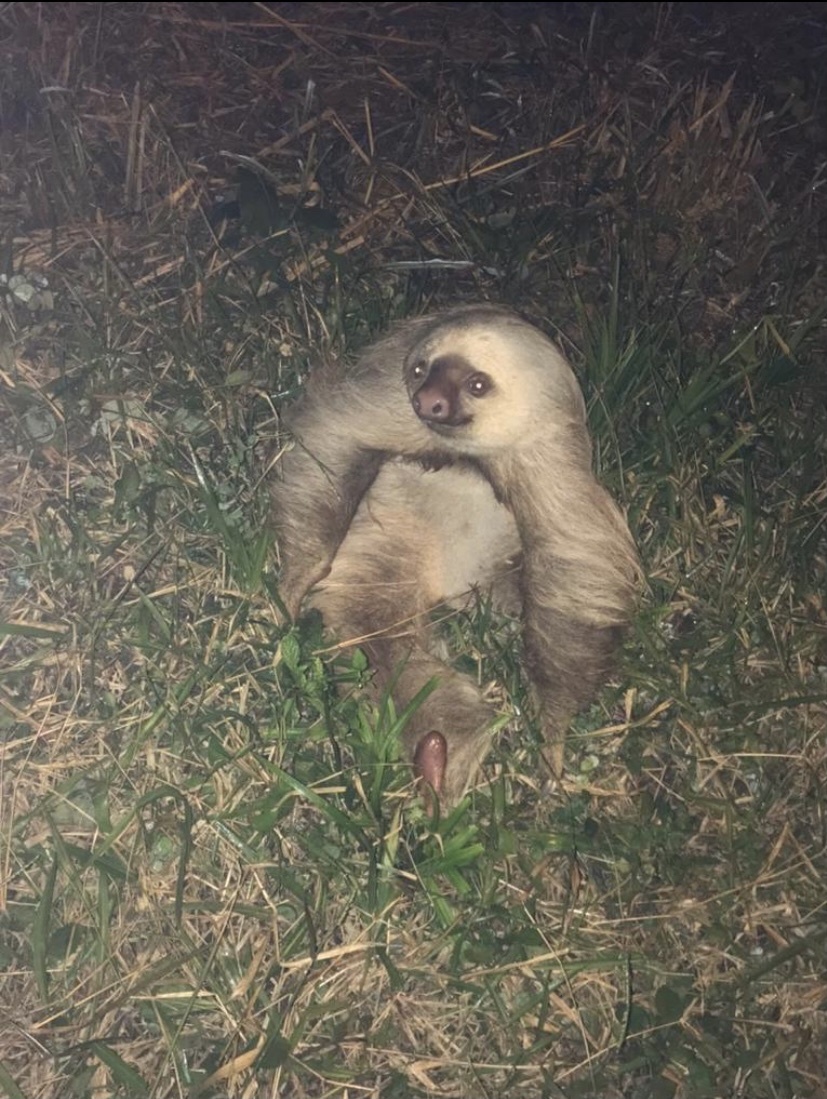
The Hoffmann's two-toed sloth (Choloepus hoffmanni), also known as the northern two-toed sloth, is a species of sloth from Central and South America. It is a solitary, largely nocturnal and arboreal animal, found in mature and secondary rainforests and deciduous forests. The common name commemorates the German naturalist Karl Hoffmann, who discovered the Hoffmann sloth.
Description
Skull of a Hoffmann's two-toed sloth
Hoffmann's two-toed sloth is a heavily built animal with shaggy fur and slow, deliberate movements. The fore feet have only two toes, each ending with long, curved claws, although three clawed toes are on each of the hind feet. Other features that distinguish it from three-toed sloths, which may be found in the same geographic areas, include the longer snout, separate rather than partially fused toes of the forefeet, the absence of hair on the soles of the feet, fewer dark markings around the eyes, and larger overall size. The wrist of the sloth has developed some specific traits due to their slow, yet acrobatic motions. These evolved traits include diminution and distal migration of the pisiform bone, with a loss of contact with the ulna; reduction of the distal end of the ulna to a styloid process; and extremely reduced contact between the ulna and triquetral bone.
Hoffmann's two-toed sloth is, however, much easier to confuse with the related Linnaeus's two-toed sloth, which it closely resembles. The primary physical differences between the two species relate to subtle skeletal features; for example, Hoffmann's two-toed sloth has three foramina in the upper forward part of the interpterygoid space, rather than just two, and often – but not always – has fewer cervical vertebrae.
Adults range from 54 to 72 cm (21 to 28 in) in head-body length, and weigh from 2.1 to 9 kg (4.6 to 19.8 lb). Although they do have stubby tails, just 1.5 to 3 cm (0.59 to 1.18 in) long, this is too short to be visible through the long...