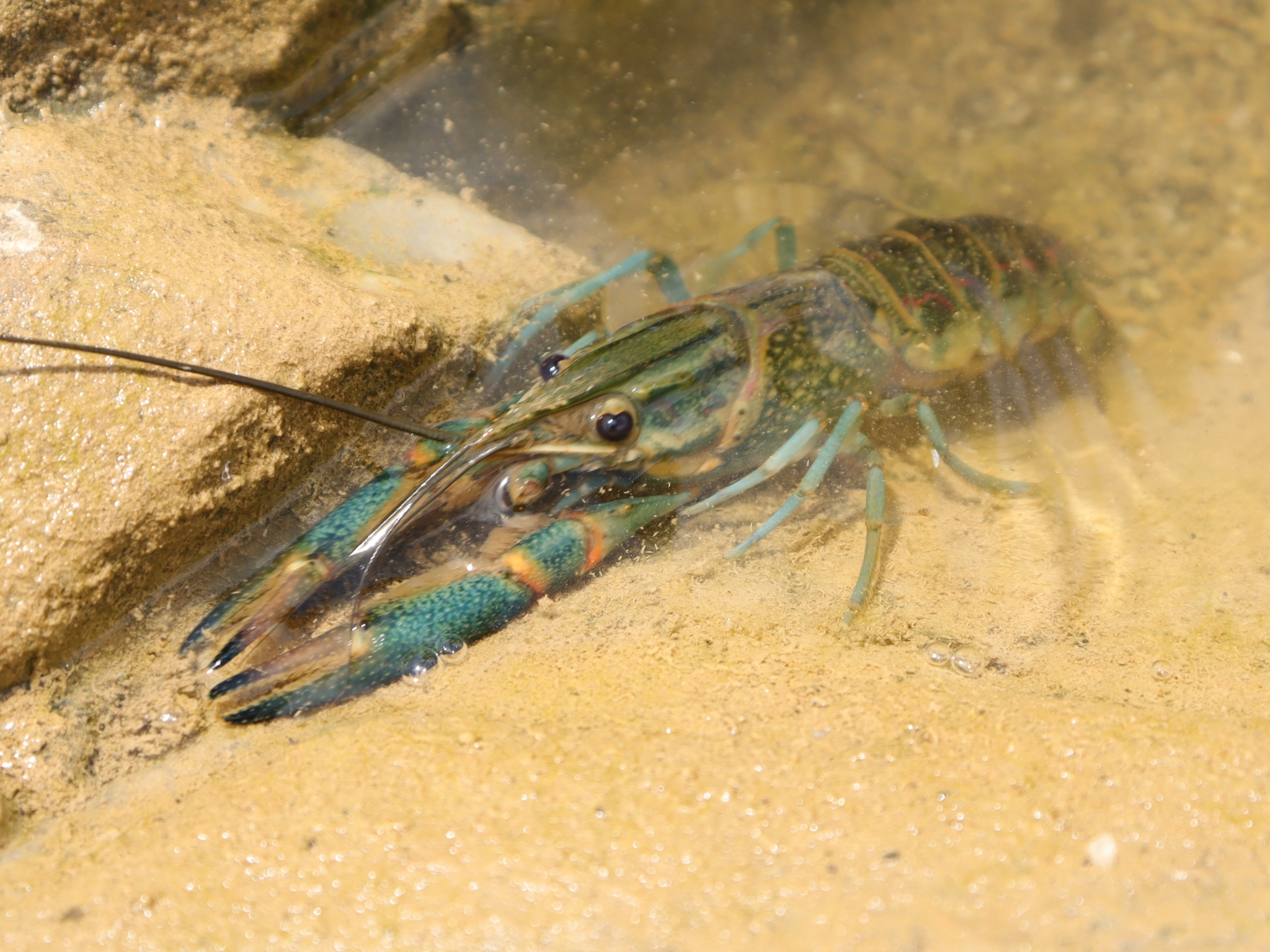
Cherax, commonly known as yabby/yabbies in Australia, is the most widespread genus of fully aquatic crayfish in the Southern Hemisphere. Various species of cherax may be found in both still and flowing bodies of freshwater across most of Australia and New Guinea.
Habitat
Members of the Cherax genus can be found in lakes, rivers, and streams across most of Australia and New Guinea. Together with Euastacus, it is also the largest crayfish genus in the Southern Hemisphere.
The most common and widely distributed species in Australia is the common yabby (C. destructor). It is generally found in lowland rivers and streams, lakes, swamps, and impoundments at low to medium altitude, largely within the Murray–Darling Basin. Common yabbies are found in many ephemeral waterways, and can survive dry conditions for long periods of time (at least several years) by aestivating (lying dormant) in burrows sunk deep into muddy creek and swamp beds.
In New Guinea, Cherax crayfish are found widely in rivers, streams, and lakes, with a particularly high diversity in the Paniai Lakes. New Guinea is also home to the only known cave-living crayfish in the Southern Hemisphere, C. acherontis.
Some species are very colourful and sometimes seen in the freshwater aquarium trade. A new species, coloured bright blue, was found in streams in West Papua after being discovered via the aquarium trade in Australia around 2015, and was named Cherax pulcher, pulcher meaning "beautiful".
Reproduction
The mating season for Cherax is during early spring. After fertilisation, eggs develop inside the mother's body for 4 to 6 weeks. After that period, the eggs transition to the outside of the mother's body and rest on the female's tail. Then the eggs continue to develop and hatch in spring.
Yabbies can inhabit shallow creeks during the wet season and burying themselves during droughts
Both sexes of Cherax are selective with copulation partners. Females tend to choose males with a...