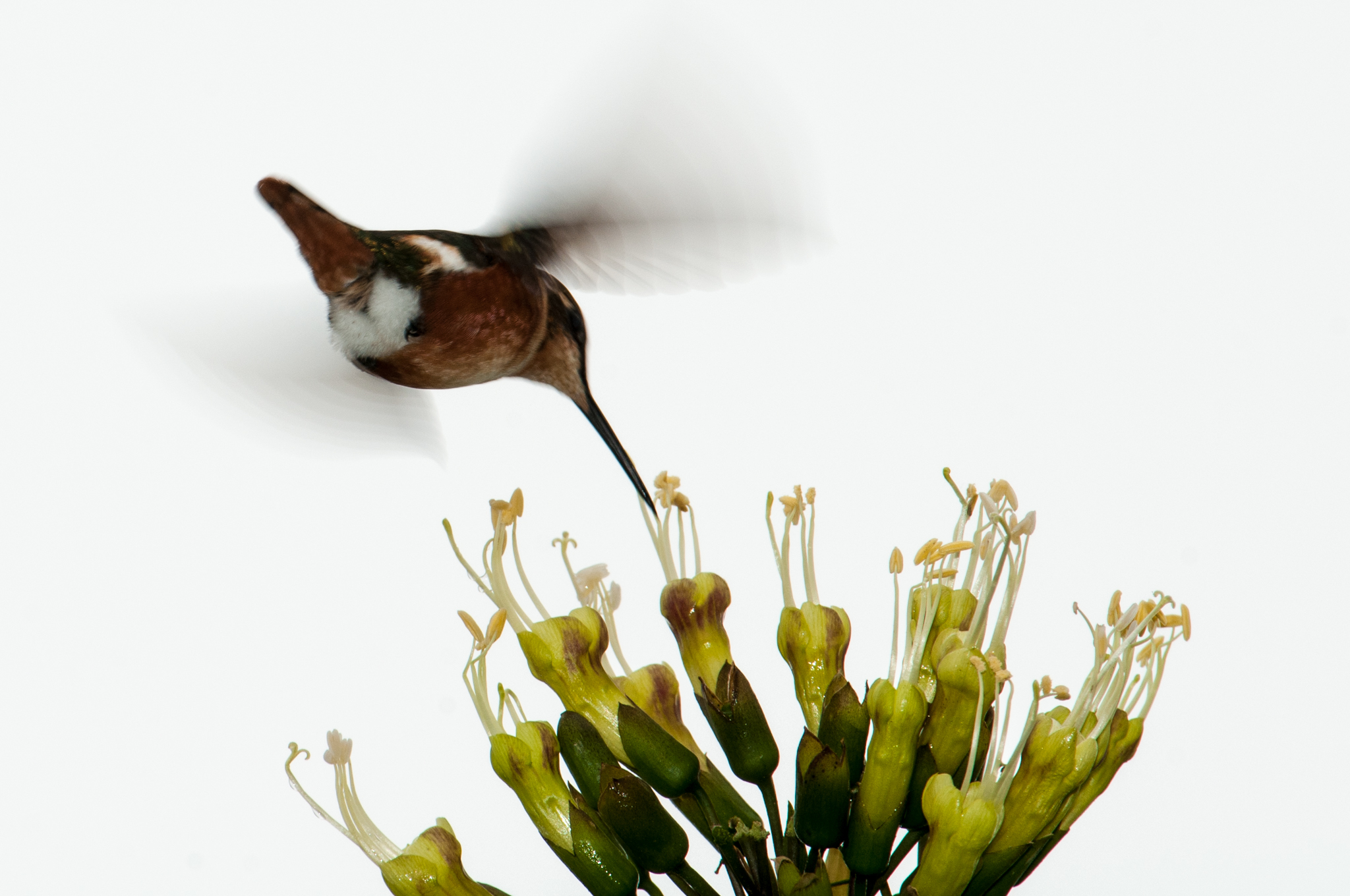
The amethyst woodstar (Calliphlox amethystina) is a species of hummingbird in tribe Mellisugini of subfamily Trochilinae, the "bee hummingbirds". It is found in every mainland South American country except Chile and Uruguay and has been recorded as a vagrant on Trinidad.
Taxonomy and systematics
The South American Classification Committee of the American Ornithological Society, the International Ornithological Committee (IOC), and the Clements taxonomy consider the amethyst woodstar to be the only member of genus Calliphlox. However, BirdLife International's Handbook of the Birds of the World (HBW) also includes the magenta-throated woodstar (as C. bryantae) and purple-throated woodstar (as C. mitchellii) in that genus. The other three taxonomies assign them to genus Philodice. The species is monotypic.
The amethyst woodstar was described by the French polymath Georges-Louis Leclerc, Comte de Buffon in 1781 in his Histoire Naturelle des Oiseaux. The bird was also illustrated in a hand-colored plate engraved by François-Nicolas Martinet in the Planches Enluminées D'Histoire Naturelle which was produced under the supervision of Edme-Louis Daubenton to accompany Buffon's text. Neither the plate caption nor Buffon's description included a scientific name but in 1783 the Dutch naturalist Pieter Boddaert coined the binomial name Trochilus amethystinus in his catalogue of the Planches Enluminées. The type locality is Cayenne in French Guiana. The amethyst woodstar is now placed in the genus Calliphlox that was introduced by the German zoologist Friedrich Boie in 1831. The generic name is derived from the Ancient Greek kalliphlox meaning "beautifully blazing". The specific epithet is Latin for "amethyst-colored".
The genus Calliphlox, which presently only contains C. amethystina, formerly also had several other species classified within it; the Bahama woodstar, Inagua woodstar, purple-throated woodstar, and magenta-throated woodstar. However, a molecular phylogenetic study of...