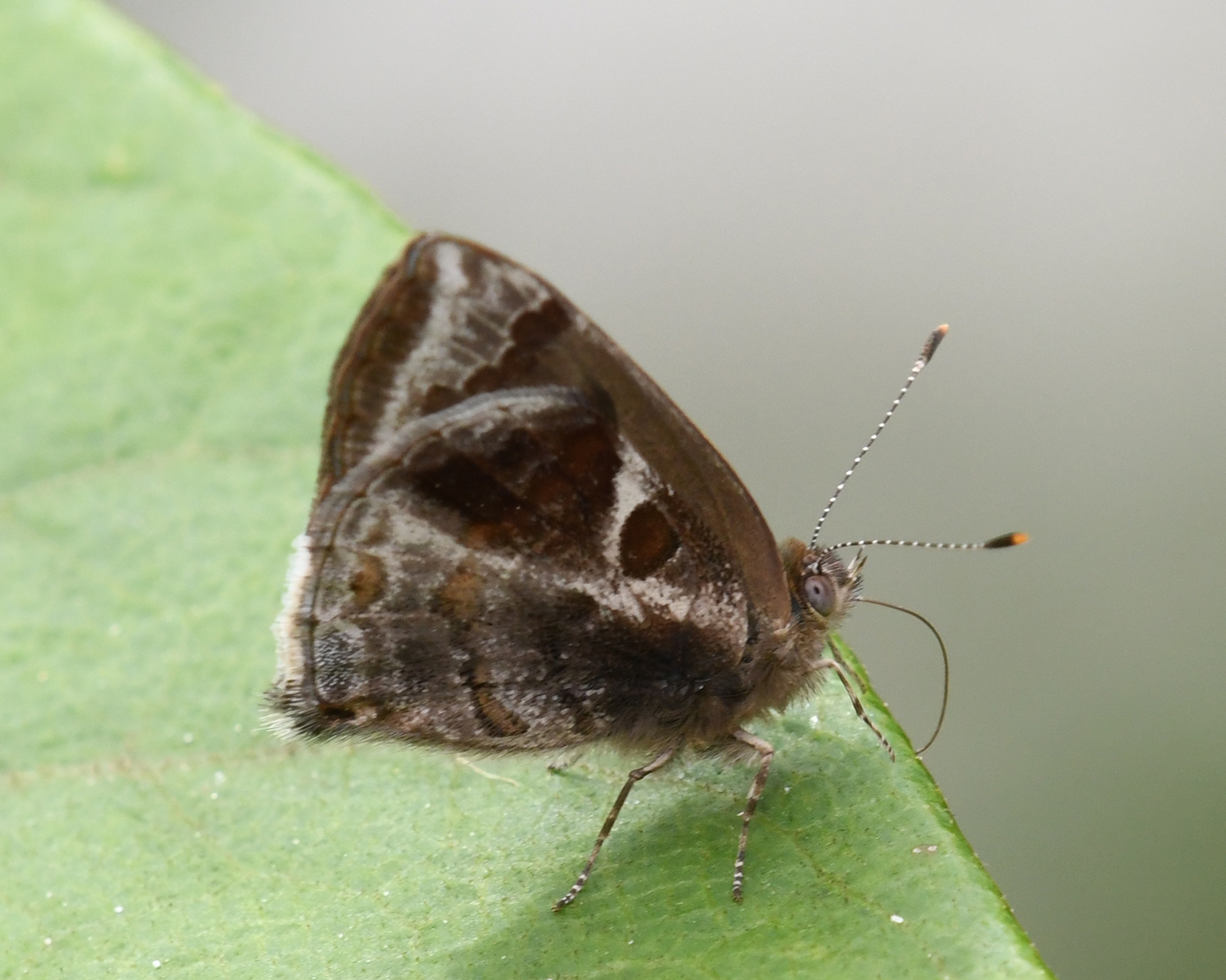
The subfamily Theclinae is a group of butterflies, often referred to as hairstreaks, with some species instead known as elfins or by other names. The group is part of the family Lycaenidae, the "gossamer-winged butterflies". There are many tropical species as well as a number found in the Americas. Tropical hairstreaks often have iridescent blue coloration above, caused by reflected light from the structure of the wing scales rather than by pigment. Hairstreaks from North America are commonly brown above. Few Theclinae are migratory. Members of this group are described as 'thecline'.
Family characteristics
Morphology: Members of the Lycaenidae family, including Theclinae, typically possess smooth or hairy eyes bordered by white scales. The labial palps are forward-projecting or slightly upturned, and the antennae are approximately half the length of the forewing, ending in elongated clubs. Both sexes have fully functional legs, although male forelegs are often reduced compared to females. Forewing venation includes 10 to 11 veins, with vein 8 often absent and vein 9 sometimes missing. The wing cell is narrower than in most other butterfly families. Distinct sexual dimorphism is common, and the undersides of the wings frequently feature unique spot patterns, contrasting sharply with the often iridescent uppersides. Some genera have a short hindwing tail at vein 2, contributing to their mimicry strategy.
Eggs are disc-shaped, featuring a finely reticulated surface of ribs and hollows. Recent studies, such as those examining species from the Russian Far East, reveal that the morphology of Theclinae eggs varies between genera and can aid in taxonomic classification. These structural differences offer insights into evolutionary relationships and are an emerging focus of research in Theclinae systematics.
Larvae: Caterpillars are typically woodlouse-shaped, yellow-green, and covered in short, downy hairs. They bear dark green longitudinal stripes and oblique bars, turning...