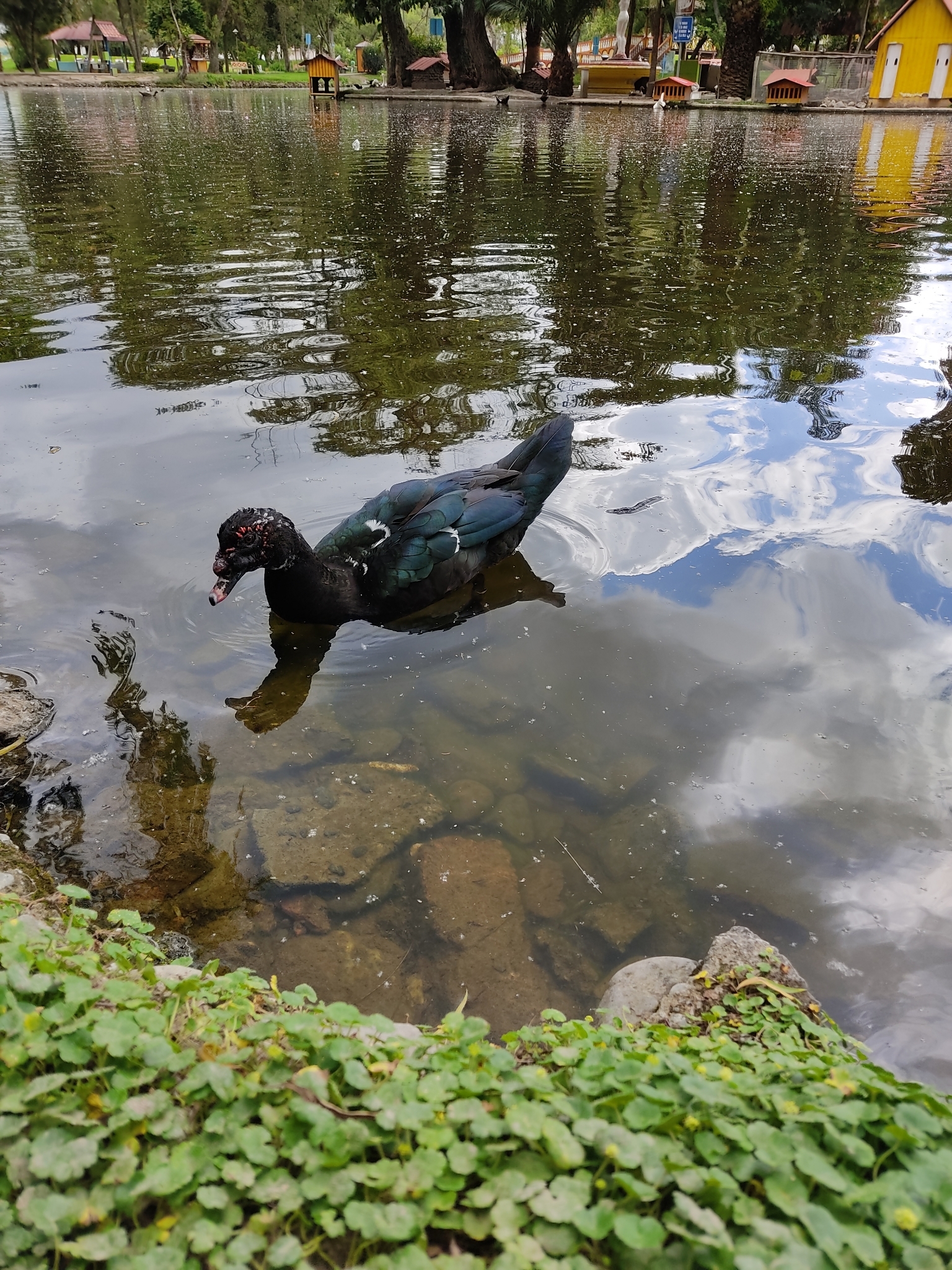
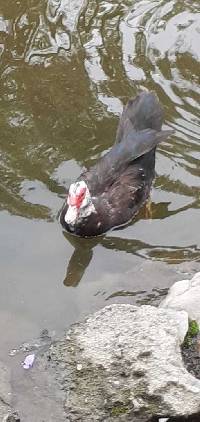
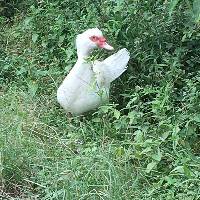
The Muscovy duck (Cairina moschata) is a species of duck native to the Americas, from the Lower Rio Grande Valley of Texas and Mexico south to Argentina and Uruguay. The species has been domesticated, and feral Muscovy ducks can be found locally in New Zealand, Australia, the United States, and in Central and Eastern Europe.
Description
Male, showing underwing pattern; Transpantaneira, Poconé, Mato Grosso, Brazil
Male, showing upperwing pattern; Transpantaneira, Poconé, Mato Grosso, Brazil
It is a large duck, with the males significantly larger than the females. The males are 76–84 cm (30–33 in) long and weigh up to 3–4 kg (6.6–8.8 lb); females are 71–76 cm (28–30 in) long and 1.25 kg (2.8 lb) weight, roughly half the weight of the males. The wingspan is from 137 to 152 cm (54 to 60 in). The plumage is predominantly black, with large white patches on the wing; the back and wing feathers being iridescent and glossy in males, while the females are more drab. Muscovy ducks have long claws on their feet and a wide, flat tail.
On the head, the male has a short crest on the nape. The bill is black with a speckling of pale pink. A blackish or dark red knob can be seen at the bill base, which is similar in colour to the bare skin of the face. The eyes are yellowish-brown. The legs and webbed feet are blackish. The female is similar in plumage, but smaller, with a feathered face and lacking the prominent knob. The juvenile is duller overall, with little or no white on the wing.
The drake has a low breathy call, and the hen a quiet trilling coo.
Songs and calls
Listen to Muscovy Duck on xeno-canto
The Domestic Muscovy duck is commonly known in Spanish as the pato criollo. They have been bred since pre-Columbian times by Native Americans and are heavier and less able to fly long distances than wild birds. Their plumage is also more variable, often with extensive white. Although the...