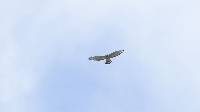
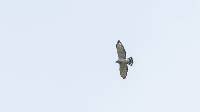
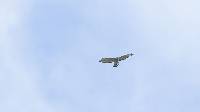
The broad-winged hawk (Buteo platypterus) is a medium-sized hawk of the genus Buteo. During the summer, some subspecies are distributed over eastern North America, as far west as British Columbia and Texas; they then migrate south to winter in the Neotropics from Mexico south to southern Brazil. Other subspecies are all-year residents on Caribbean islands. As in most raptors, females are slightly larger than males. Broad-winged hawks' wings are relatively short and broad with a tapered, somewhat pointed appearance. The two types of coloration are a dark morph with fewer white areas and a light morph that is more pale overall. Although the broad-winged hawk's overall population is increasing, populations are declining in some parts of its breeding range because of forest fragmentation.
Description
Broad-winged hawk at Isle Royale National Park
Sheepshead Sanctuary South Padre Island - Texas
Molting feather pattern, only visible in May/June
The broad-winged hawk is a relatively small Buteo, with a body size from 32 to 44 cm (13 to 17 in) in length and weighing 265 to 560 g (9.3 to 19.8 oz). The tail is relatively short, measuring 14.5–19.0 cm (5.7–7.5 in) in length. The tarsus measures from 5.6 to 6.6 cm (2.2 to 2.6 in). As in most raptors, females are slightly larger than males. Broad-winged hawks have relatively short and broad wings, pointed at the end, which have a tapered appearance unique to the species. The wingspan can range from 74 to 100 cm (29 to 39 in), with the extended wing bone (standard measurement) measuring 22.7–30 cm (8.9–11.8 in).
An adult's body is a dark brown with a white belly and chest containing horizontal barring. Its tail can be a dark grey-black with white lines along the middle, base, and tip. The young hawks have a slightly different coloring with more white and longitudinal barring instead of horizontal barring. The two types of coloration are a dark morph with fewer...