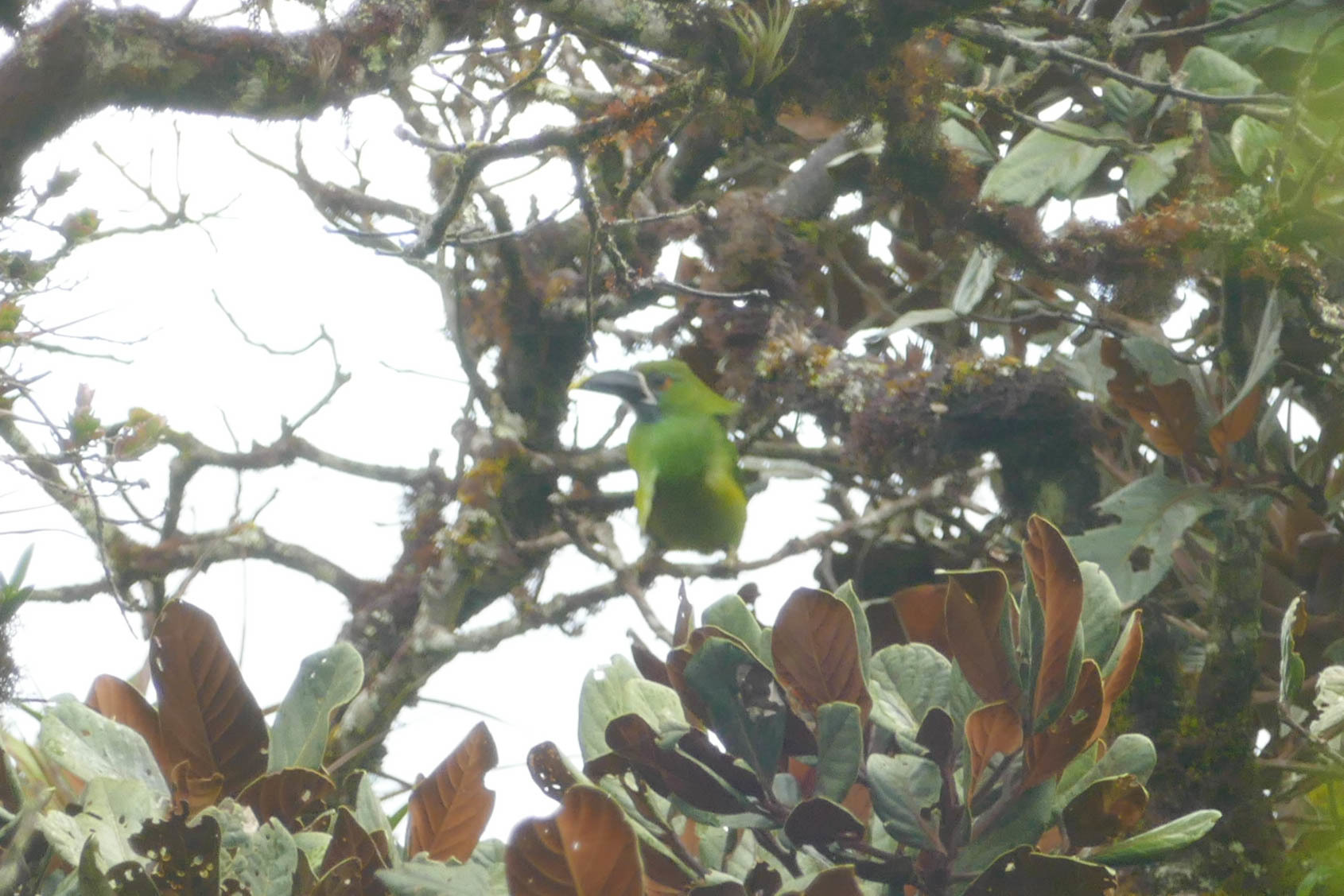
The southern emerald toucanet (Aulacorhynchus albivitta) is a bird in the toucan family Ramphastidae. It is found in montane regions of Colombia, Ecuador, western Venezuela, Peru and northern Bolivia.
Taxonomy
The southern emerald toucanet was formally described in 1840 as Pteroglossus albivitta by the French ornithologist Auguste Boissonneau based on a specimen collected in Bogotá, Colombia. The specific epithet combines Latin albus meaning "white" with vitta meaning "band" or "head-band". The southern emerald toucanet is now one of eight toucanets placed in the genus Aulacorhynchus that was introduced in 1835 by John Gould.
For many years what was then known as the emerald toucanet was considered to have 14 subspecies. In 2008 the International Ornithological Committee (IOC) divided the subspecies into five species based on differences in morphology and mitochondrial DNA sequences. The five species were the emerald toucanet (A. prasinus) with four subspecies, the blue-throated toucanet (A. caeruleogularis) with two subspecies, the white-throated toucanet (A. albivitta) with four subspecies, the black-throated toucanet (A. atrogularis) with three subspecies and the monotypic Wagler's toucanet (A. wagleri). In 2025, based on the relatively modest differences, AviList chose instead to recognise only two species, the northern emerald toucanet (A. prasinus) with seven subspecies and the southern emerald toucanet (A. albivitta) also with seven subspecies.
Seven subspecies are recognised:
A. a. lautus Bangs, O, 1898 – Santa Marta Mountains (northeastern Colombia)
A. a. griseigularis Chapman, FM, 1915 – northern end of western Andes and west slope of central Andes of Colombia
A. a. phaeolaemus Gould, J, 1874 – subtropical western Andes of Colombia
A. a. albivitta (Boissonneau, A, 1840) – eastern and central Andes of Colombia, eastern Ecuador, and western Venezuela
A. a. cyanolaemus (Gould, J, 1866) – subtropical Andes of southeastern Ecuador and...