Viola sororia ( vy-OH-lə sə-ROR-ee-ə), known commonly as the common blue violet, is a short-stemmed herbaceous perennial plant native to eastern North America. It is known by a number of common names, including common meadow violet, purple violet, woolly blue violet, hooded violet, and wood violet.
This perennial plant is distributed in the eastern half of the United States, Canada, and a part of eastern Mexico. Its native habitats are rich, moist woods, and swamps located in the eastern half of the United States and Canada. Its cultivar 'Albiflora' has gained the Royal Horticultural Society's Award of Garden Merit.
Self-seeding freely in lawns and gardens, it can be considered a weed by some. Cleistogamous seed heads may also appear on short stems in late summer and early autumn.
Description
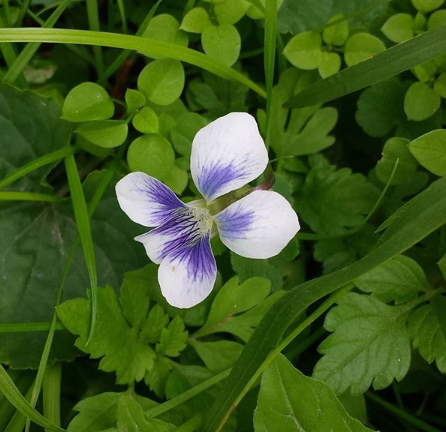
Common Blue Violet (Viola sororia) color variant
Viola sororia is a short-stemmed, herbaceous perennial plant that grows in well-drained and shady habitats. This 15–25 centimeters (6–10 in) wide violet has glossy, heart-shaped leaves and are topped with purple flowers with white throats. The lower three petals are hairy and the stem of the flower droops slightly. These flowers can be found in the woods, thickets, and near stream beds. V. sororia can live and reproduce for more than 10 years. Blooming in the spring and summer (April–August), Viola sororia can be found in colors of white, blue, or purple.
Taxonomy
Hairless common blue violets with purple flowers and bearded spurred petals have been variously called Viola sororia, Viola affinis, and Viola pratincola. In the Chicago region, this hairless form is most frequently found in weedy areas such as old fields and lawns. Hairy purple violets with blue flowers have been called "true" Viola sororia and are rarely seen outside of remnant wooded areas.
A form with white flowers that have a purple center has been called Viola sororia f. priceana (Confederate violet).