Senecio vulgaris, often known by the common names groundsel and old-man-in-the-spring, is a flowering plant in the family Asteraceae. It is an annual herb, native to the Palaearctic and widely naturalised as a ruderal species in suitable disturbed habitats worldwide.
Description
Dew-covered common groundsel flower in New Jersey
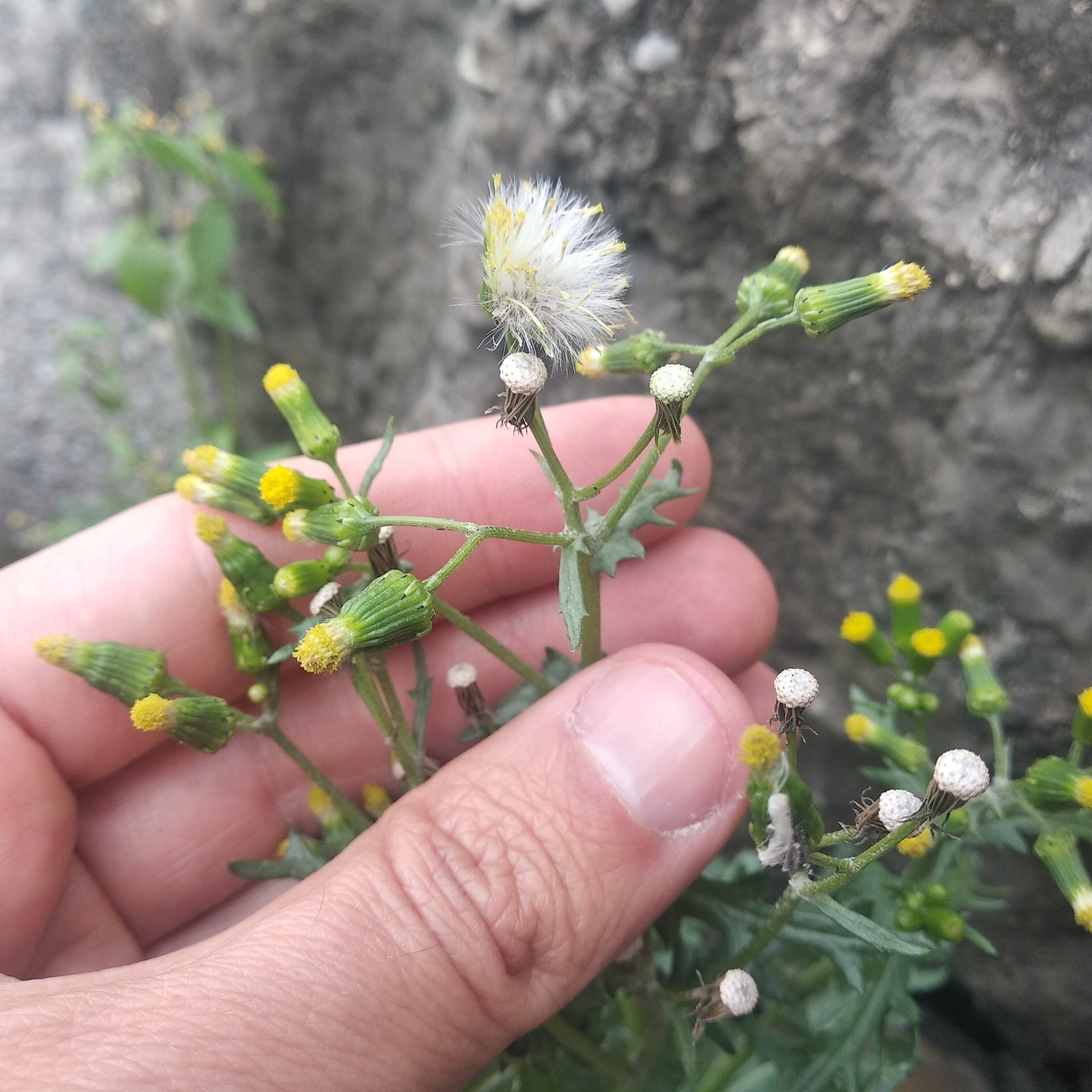
Senecio vulgaris is an erect, herbaceous annual growing up to 16 inches (41 cm) tall. The inflorescences usually lack ray florets and the yellow disc florets are mostly hidden by the bracts, giving the flowers an inconspicuous appearance. S. vulgaris is very similar to Senecio viscosus, but S. vulgaris does not have the glandular hairs and ray florets found in S. viscosus.
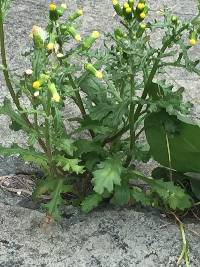
Upper leaves of S. vulgaris are sessile, lacking their own stem (petiole), alternating in direction along the length of the plant, two rounded lobes are at the base of the stem (auriculate) and subclasping above. The leaves are pinnately lobed and about 2.4 inches (61 mm) long and 1 inch (25 mm) wide, smaller towards the top of the plant. They are sparsely covered with soft, smooth, fine hairs. The leaf lobes typically are sharp to rounded saw-toothed.
The hollow stems branch at the tops and from the base. Stems and leaves can both host the Cineraria leaf rust.
Open clusters of 10 to 22 small, cylinder-shaped, rayless yellow flower heads
The name for the genus Senecio is probably derived from senex (an old man), in reference to its downy head of seeds; "the flower of this herb hath white hair and when the wind bloweth it away, then it appeareth like a bald-headed man" and like its family, flowers of S. vulgaris are succeeded by downy globed heads of seed. The seeds are achenes, include a pappus,
and become sticky when wet.
Laboratory tests have suggested maximum seed scattering distances of 4.2 and 4.6 yd (3.8 and 4.2 m) at wind speeds of 6.8 and 10.2 mph (10.9 and 16.4 km/h) respectively...