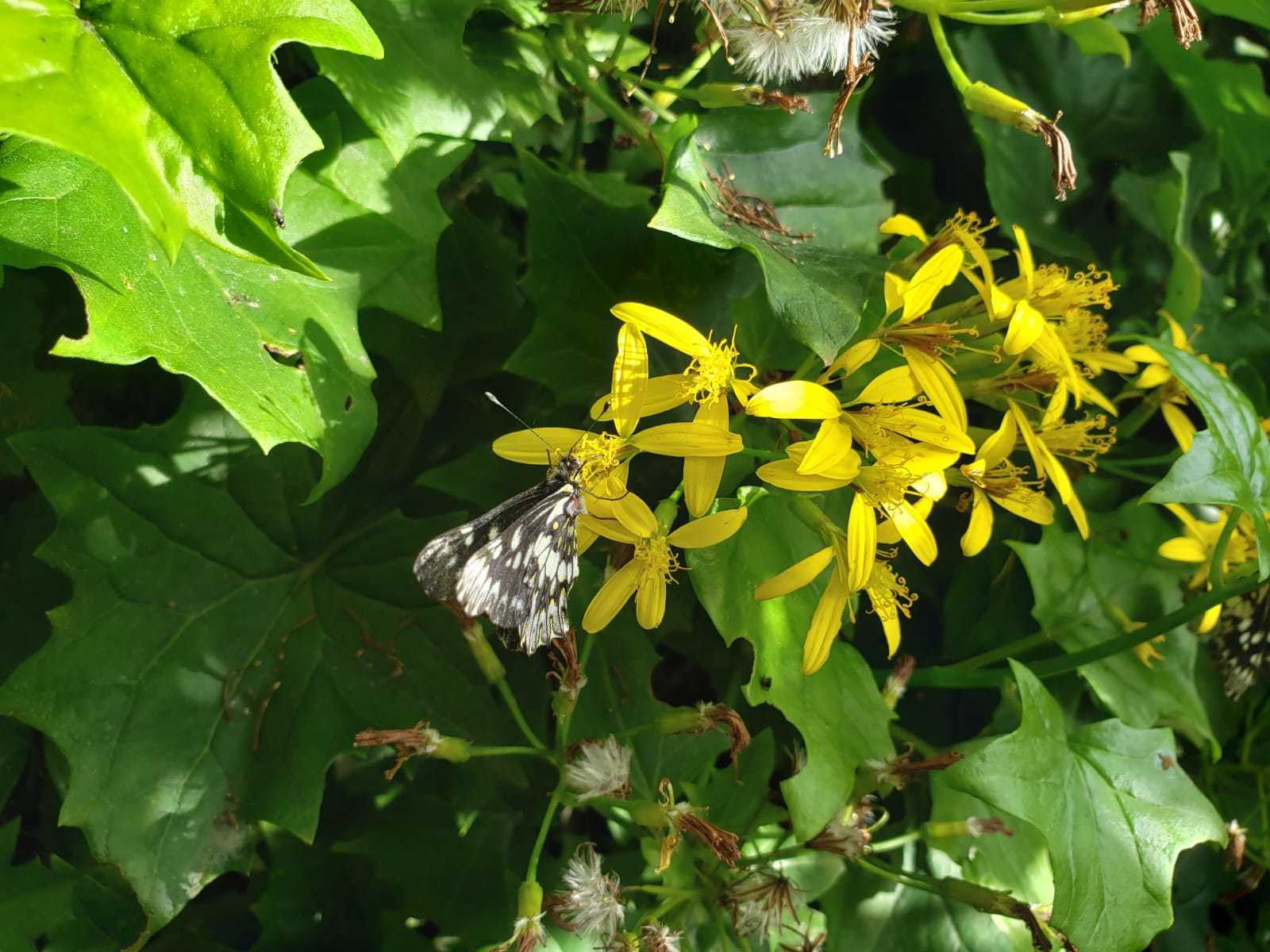
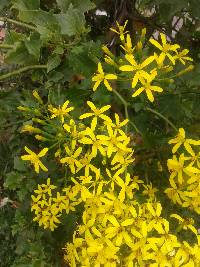
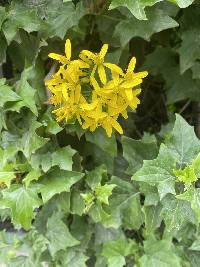
Senecio tamoides, also known as Canary creeper, is a climbing member of the genus Senecio of the family Asteraceae that is native to Southern Africa. It is used as an ornamental plant for its showy yellow, daisy-like flowers in late autumn through to winter. Other names for the plant include golden shower vine, false grapevine, and parlor ivy.
Description
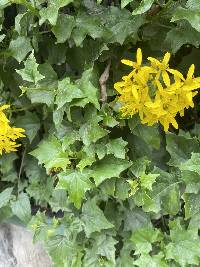
Grapevine-like leaves
It is a fast-growing, mostly evergreen, perennial climber with semi-succulent stems and leaves
that creeps along the ground or twines several meters into the trees to reach the sunlit canopy where it can flower. It grows up to a height of 2 metres (6.6 ft) to 4 metres (13 ft) tall, though it can be as much as 10 metres (33 ft) tall in the right conditions.
Its stems are slender, 3 centimetres (1.2 in) to 4 centimetres (1.6 in) in diameter, usually purplish, semi-succulent and hairless that have a clear and sticky exudate.
Leaves are bright green, palmately lobed with purple venation, shaped like many ivy with broad, oval and fleshy surfaces, 4 centimetres (1.6 in) long and 7 centimetres (2.8 in) wide, coarsely toothed edges, leaf stalks 2 centimetres (0.79 in) to 5 centimetres (2.0 in) long.
Close up of flowers
Its inflorescence is many-headed, bright yellow, and the raceme grows to have a flat top. The flower heads are cylindrical, about 3 millimetres (0.12 in) in diameter; surrounded with a whorl of five to seven bracts, 6 millimetres (0.24 in) to 7 millimetres (0.28 in) long which are surrounded by two to four smaller bracts or bracteoles. Flowers are cinnamon-scented that generally appear from mid autumn to winter. In New South Wales, it flowers in winter. In Western Australia, it flowers between April and May.
Three to six ray florets; each ligule approximately 1 centimetre (0.39 in) long; ten to twelve disc florets, 12 millimetres (0.47 in) to 15 millimetres (0.59 in) long. When cultivated...