Rivina humilis is a species of flowering plant in the family Petiveriaceae. It was formerly placed in the pokeweed family, Phytolaccaceae. It can be found in the southern United States, the Caribbean, Central America, and tropical South America. Common names include dogblood, pigeonberry, rougeplant, baby peppers, bloodberry, and coralito. The specific epithet means "dwarfish" or "lowly" in Latin, referring to the plant's short stature.
Description
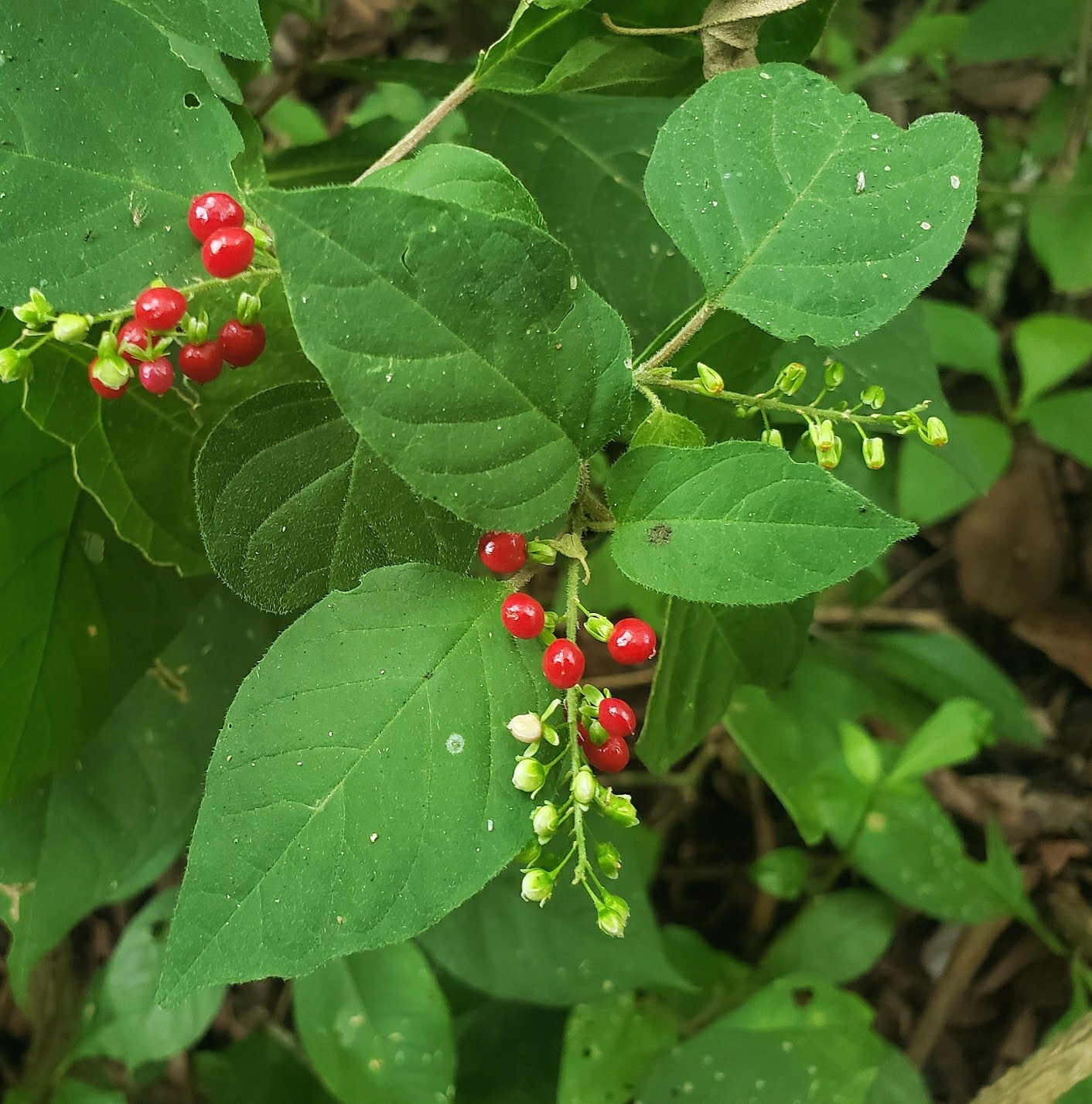
Pigeonberry is an erect, vine-like herb, reaching a height of 0.4–2 m (1.3–6.6 ft). The leaves of this evergreen perennial are up to 15 cm (5.9 in) long and 9 cm (3.5 in) wide, with a petiole 1–11 cm (0.39–4.33 in) in length. Flowers are on racemes 4–15 cm (1.6–5.9 in) long with a peduncle 1–5 cm (0.39–1.97 in) in length and pedicels 2–8 mm (0.079–0.315 in) long. Sepals are 1.5–3.5 mm (0.059–0.138 in) in length and white or green to pink or purplish. The fruit is a glossy, bright red berry 2.5–5 mm (0.098–0.197 in) in diameter.
Rivina humilis plant with fruit and flowers.
Habitat
Rivina humilis can be found in forests, thickets, shell middens, hammocks, roadsides, and disturbed areas at elevations from sea level to 1,700 m (5,600 ft). It requires less than partial sun and is tolerant of full shade. It is also tolerant of salt spray and saline soils.
It is considered invasive in New Caledonia, where it was likely introduced in 1900. It is considered a weed in Queensland, Australia where it has naturalised, and is also naturalised on Cocos Islands, Réunion, Norfolk Island, Fiji, Tonga, French Polynesia, Hawaii, India and the Galapagos Islands.
Uses
Pigeonberry is cultivated as an ornamental in warm regions throughout the world and is valued as a shade-tolerant groundcover. It is also grown as a houseplant and in greenhouses.
The juice made from the berries was used as a dye and ink at one...