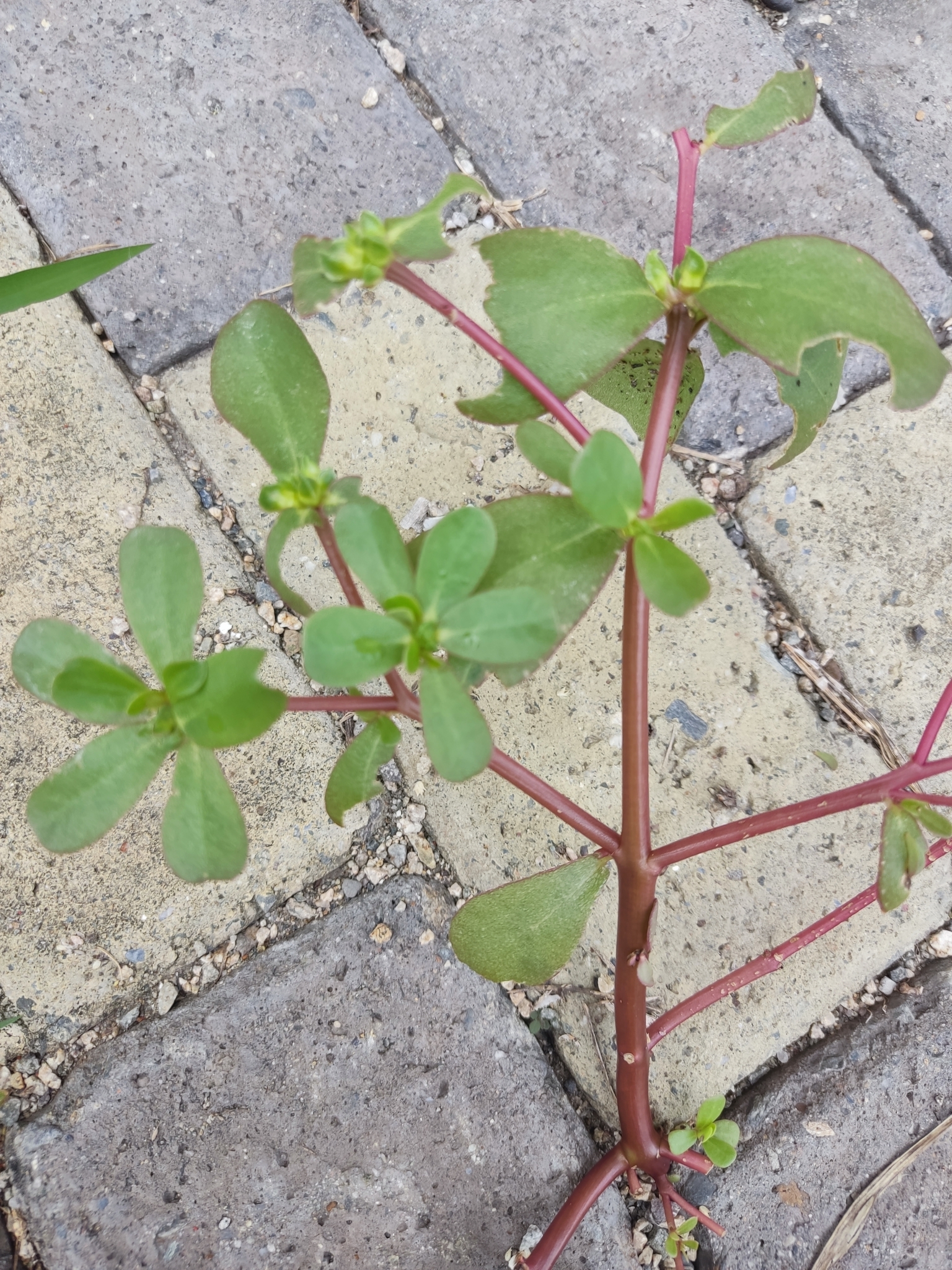
Portulaca oleracea (common purslane, also known as little hogweed, or pursley) is a succulent plant in the family Portulacaceae. All parts of the plant are edible raw or cooked.
Taxonomy
P. o. sativa
P. oleracea was recorded in 1753 by Carl Linnaeus in Species Plantarum. Due to the great variability, a large number of subspecies and varieties have been described as species of their own, but according to other publications, they all fall within the range of variation of P. oleracea. The synonyms P. oleracea subsp. sativa, P. sativa, and P. oleracea var. sativa, which are more common in the literature, refer to a somewhat more robust form in cultivation with larger seeds that cannot be separated from the species. Approximately 40 cultivars of P. oleracea are currently grown.
The flowering plant more commonly known as winter purslane (Claytonia perfoliata) is a member of the Montiaceae family and is not closely related.
Two varieties are accepted.
Portulaca oleracea var. delicatula Fosberg – endemic to Aldabra in the Seychelles
Portulaca oleracea var. oleracea – native to full species range
The specific epithet oleracea means "vegetable/herbal" in Latin and is a form of holeraceus (oleraceus), from holus 'vegetable'. The genus name portulāca is simply the plant's name in Latin.
Varieties
Two varieties are accepted.
Portulaca oleracea var. delicatula Fosberg – endemic to Aldabra in the Seychelles
Portulaca oleracea var. oleracea – native to full species range
Etymology
The specific epithet oleracea means "vegetable/herbal" in Latin and is a form of holeraceus (oleraceus), from holus 'vegetable'. The genus name portulāca is simply the plant's name in Latin.
Distribution and habitat
Purslane has an extensive distribution, assumed to be mostly anthropogenic (or hemerochoric), extending from North Africa and Southern Europe through the Middle East and the Indian subcontinent to Malesia and Australasia. The species status in the...