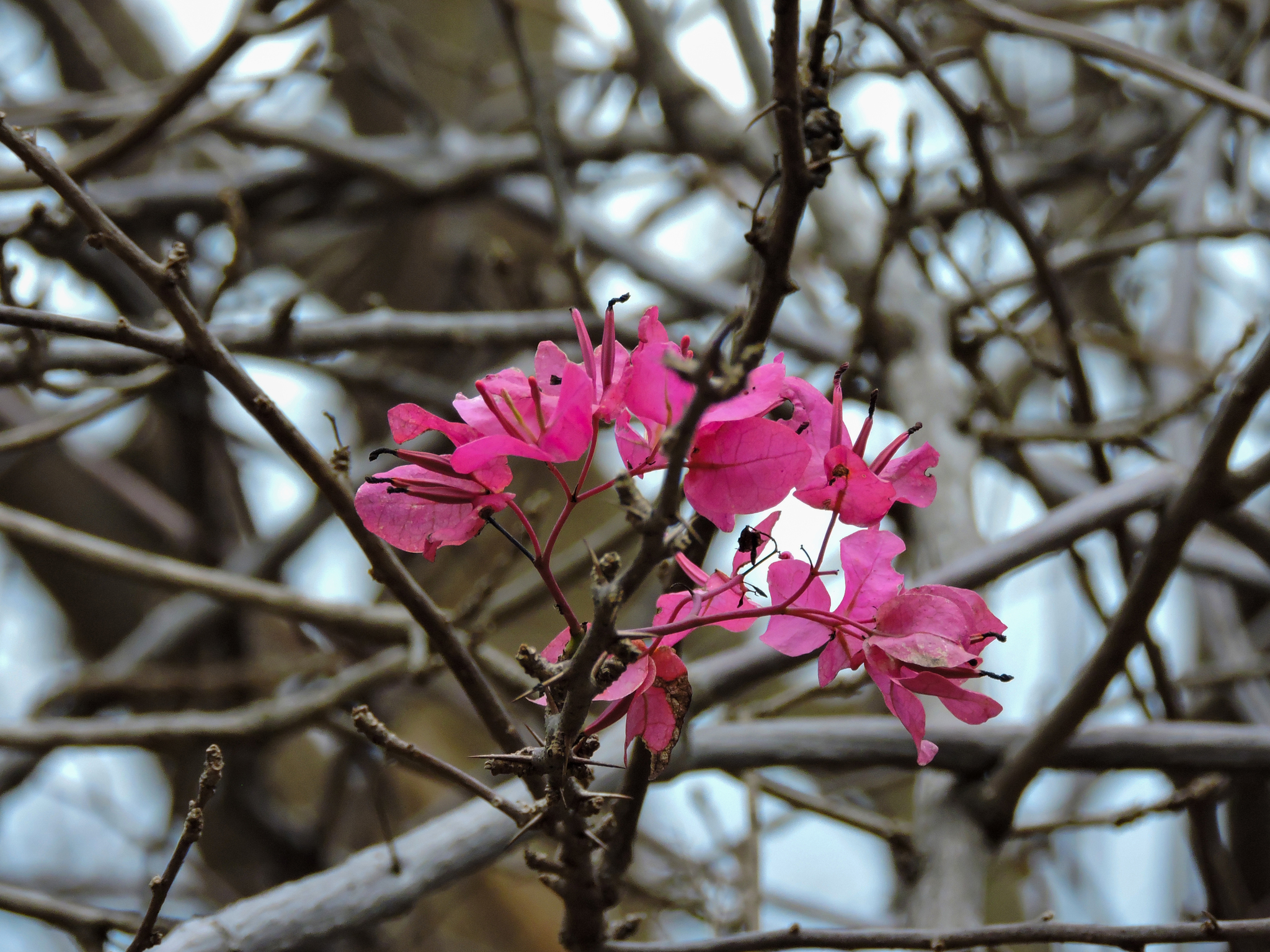
Bougainvillea ( BOO-gən-VIL-ee-ə, US also BOH-) is a genus of thorny ornamental vines, bushes, and trees belonging to the family Nyctaginaceae. They are native to the tropical forests of South America (specifically Brazil, Bolivia, Paraguay, Peru, Uruguay and Argentina). There are between 4 and 22 species in the genus. The inflorescence consists of large colorful sepal-like bracts which surround three simple waxy flowers, gaining popularity for the plant as an ornamental. The plant is named after explorer Louis Antoine de Bougainville (1729–1811), after it was documented on one of his expeditions.
Description
Close-up photo of Bougainvillea spectabilis in Hawaii, showing thorns
The species grows 1 to 12 metres (3 to 39 ft) tall, scrambling over other plants with their spiky thorns. They are evergreen where rainfall occurs all year, or deciduous if there is a dry season. The leaves are alternate, simple ovate-acuminate, 4–13 cm (1.6–5.1 in) long and 2–6 cm (0.79–2.4 in) broad. The actual flower of the plant is small and generally white, but each cluster of three flowers is surrounded by three or six bracts with the bright colours associated with the plant, including pink, magenta, purple, red, orange, white, or yellow. Bougainvillea glabra is sometimes called "paper flower" because its bracts are thin and papery. The fruit is a narrow five-lobed achene.
History
The first European to describe these plants was Philibert Commerçon, a botanist accompanying French Navy admiral Louis Antoine de Bougainville during his voyage of circumnavigation of the Earth, and first published by Antoine Laurent de Jussieu in 1789.
Bougainvillea glabra in Kerala
Twenty years after Commerçon's description, it was first published as 'Buginvillæa' in Genera Plantarum by A. L. de Jussieu in 1789. The genus was subsequently spelled in several ways until it was finally established as "Bougainvillea" in the Index Kewensis in the 1930s. Originally,...