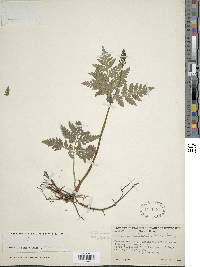
Botrypus virginianus, synonym Botrychium virginianum, sometimes called rattlesnake fern is a species of perennial fern in the adders-tongue family. It is monotypic within the genus Botrypus, meaning that it is the only species within the genus. It is called the rattlesnake fern in some parts of North America, due to its habit of growing in places where rattlesnakes are also found. Rattlesnake fern prefers to grow in rich, moist woods in dense shade and will not tolerate direct sunlight.
Description
It is a low growing species, typically being a foot high or smaller. The leaf emerges in the early spring and will senesce in late summer. The leaf is roughly triangularly shaped and 15–50 cm in size and held roughly parallel to the ground. The leaf is 3-4 times pinnately compound, brightly green colored, and feels soft to the touch. The stem is round and bicolor, being pinkish or light tan at the base but greenish nearer the branches or leaves. The diploid number is 184.
Rattlesnake fern has separate fertile and sterile leaves, when present the sterile leaf arises halfway up the stalk and the fertile leaf exists at the tip. The spores are shed in late spring. Like other ferns rattlesnake fern undergoes alternation of generations and the form described in this article is the sporophyte.
This fern has been used medicinally. In India it is still used to treat dysentery.
Taxonomy and genetics
Spore-producing frond of Botrypus virginianus
The first formal species description of Botrypus virginianus was made by Carl Linnaeus in 1753 as Osmunda virginiana.
Recent research has determined that the mitochondria are genetic chimera. DNA from some member of the Santalales, possibly a species of mistletoe, has transferred to the mitochondrial genome of this species of fern. It is believed that this transfer may have helped to enable this plant's cosmopolitan global distribution.
This plant has traditionally been included in the genus Botrychium as the subgenus...