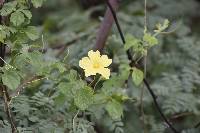
Momordica charantia (commonly called bitter melon, gouya, cerassee, goya, bitter apple, bitter gourd, bitter squash, balsam-pear, karela, karavila and many more names listed below) is a tropical and subtropical vine of the family Cucurbitaceae, widely grown in Asia, Africa, and the Caribbean for its edible fruit. Its many varieties differ substantially in the shape and bitterness of the fruit.
Its native range is distributed from Tropical and Subtropical Old World to South Pacific.
Bitter melon originated in Africa and Asia, where it was a dry-season staple food of ǃKung hunter-gatherers. Wild or semi-domesticated variants spread across Asia in prehistory, and it was likely fully domesticated in Southeast Asia. It is widely used in the cuisines of East Asia, South Asia, and Southeast Asia.
Description
This herbaceous, tendril-bearing vine grows up to 5 m (16 ft) in length. It bears simple, alternate leaves 4–12 cm (1.6–4.7 in) across, with three to seven deeply separated lobes. Each plant bears separate yellow male and female flowers. In the Northern Hemisphere, flowering occurs from June to July, and fruiting from September to November. It is a frost-tender annual in the temperate zone and a perennial in the tropics. It grows best in the USDA zones 9 to 11.
The fruit has a distinctive warty exterior and an oblong shape. It is hollow in cross-section, with a relatively thin layer of flesh surrounding a central seed cavity filled with large, flat seeds and pith. The fruit is most often eaten green, or as it is beginning to turn yellow. At this stage, the fruit's flesh is crunchy and watery in texture, similar to cucumber, chayote, or green bell pepper, but bitter. The skin is tender and edible. Seeds and pith appear white in unripe fruits; they are not intensely bitter and can be removed before cooking.
Some sources claim the flesh (rind) becomes somewhat tougher and more bitter with age, but other sources claim that at least for the...