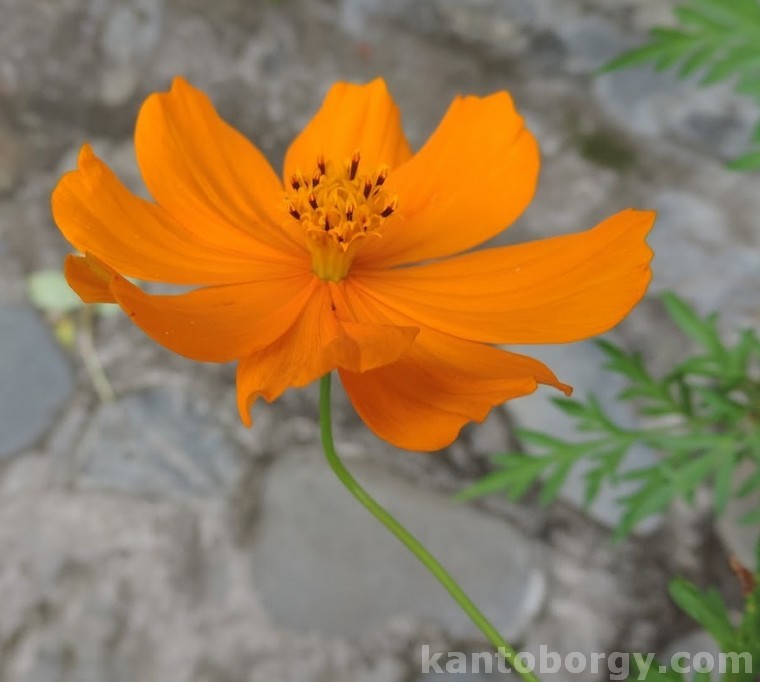
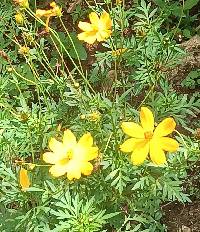
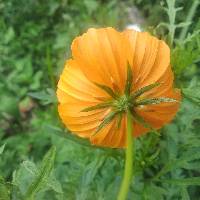
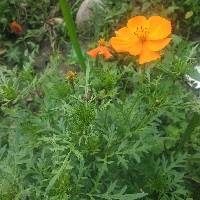
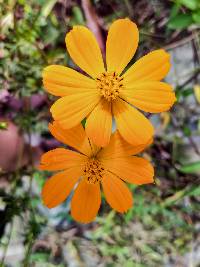
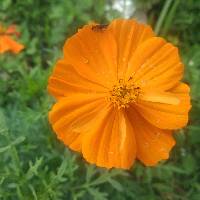
Cosmos sulphureus is a species of flowering plant in the sunflower family Asteraceae, also known as sulfur cosmos and yellow cosmos. It is native to Mexico, Central America, and northern South America, and naturalized in other parts of North and South America as well as in Europe, Asia, and Australia. It was introduced into Asia from Mexico via the Manila-Acapulco galleon trade.
This plant was declared invasive by the United States Southeast Exotic Pest Plant Council in 1996. The flowers of all Cosmos attract birds and butterflies, including the monarch butterfly.
The original and its cultivars appear in shades of yellow, orange, and red. It is especially popular in Korea and Japan, where it is often seen in mass plantings along roadsides, following an initiative pursued by the Korean-Japanese botanist Woo Jang-choon.
Description
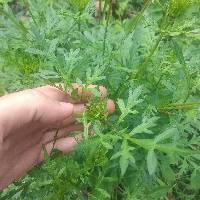
This species of Cosmos is considered a half-hardy annual, although plants may re-appear via self-sowing for several years. Its foliage is opposite and pinnately divided. The plant height varies from 1–7 feet (30–210 cm).
Cultivars
Cultivars include:
'Brightness Red'
'Bright Lights'
'Klondyke Mix', 'Polidor' consists of a variety of colors in shades from yellow to orange and scarlet
'Ladybird Dwarf Red', 'Ladybird Dwarf Gold', 'Ladybird Dwarf Orange', and 'Ladybird Dwarf Lemon' are shorter than the species at 40 cm. Their flowering is very early. The flowers have vibrant colors in hues of yellow, orange and scarlet. Another cultivar is named 'Bright Eyes'.
'The Diablo' reaches 75 cm with flowers of 5 cm intense orange red.
'The Polidor' reaches 75 cm and bears semi-double flowers in shades of golden yellow, orange and red.
'The Sunny Red' and 'Sunny Gold' have single flowers on stocky plants at 35 cm.
'The Sunset' reaches 90 cm. It bears double or semi-double flowers in shades of red or scarlet orange
'Tango' agm
(those marked agm have gained the Royal Horticultural Society's Award of Garden Merit).