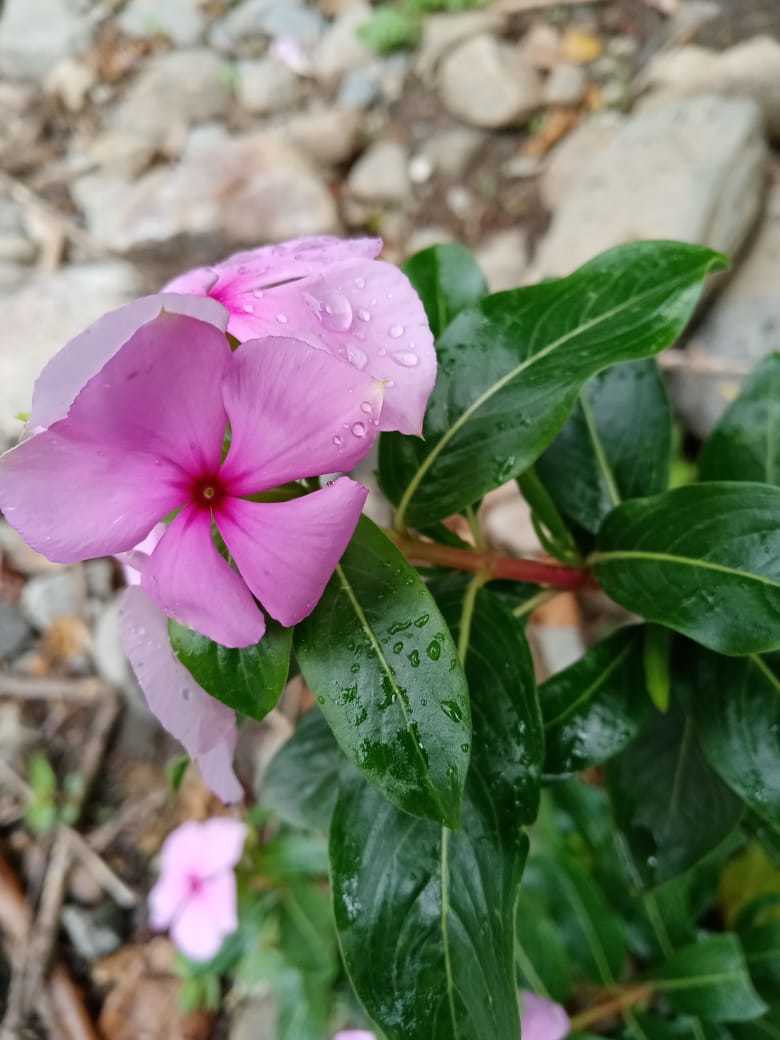
Catharanthus is a genus of flowering plants in the family Apocynaceae. Like the genus Vinca, they are known commonly as periwinkles. It is a perennial herb and a subshrub endemic to Madagascar, with the exception of Catharanthus pusillus (commonly known as the tiny periwinkle), which is found in India and Sri Lanka. The most widely known species is Catharanthus roseus due to its usage in traditional and modern medicine, specifically as a source of cancer-treating alkaloid chemicals.
Description
White Catharanthus roseus
Plants of Catharanthus are perennial herbs that are subshrubby, often with prostrate or erect stems that branch from the base of the plant. The genus was first described in 1837 by George Don. He characterized the plants by the morphological features of simple, opposite, or almost oppositely arranged leaves. The flowers are usually solitary in the leaf axils. Each has a calyx with five long, narrow lobes and a corolla with a tubular throat and five lobes that can be twisted. Fruits are commonly made up of two divergent follicles that hold many seeds. The corolla varies in color shades of pink, purple, and white.
It has also been mentioned that the genus is closely associated with the genus Amsonia, but possesses distinct differences such as Catharanthus grows mostly solitary or in pairs, while Amsonia grows in groups.
Taxonomy
The genus has undergone several taxonomic revisions since it was classified initially. The genus was originally described by Carl Linnaeus in 1753 with the species Vinca rosea (known now as Catharanthus roseus). Along with V. rosea, he distinguished two other species, Vinca major and Vinca minor. In 1828, Heinrich Gustav Reichenbach proposed a separation of V. rosea with the new name of Lochnera. However, the distinction and descriptions he intended to back up his proposal were not widely accepted in the world of botany and taxonomy. In 1838, it became an accepted proposition and name as Stephen Endlicher made a clear and...