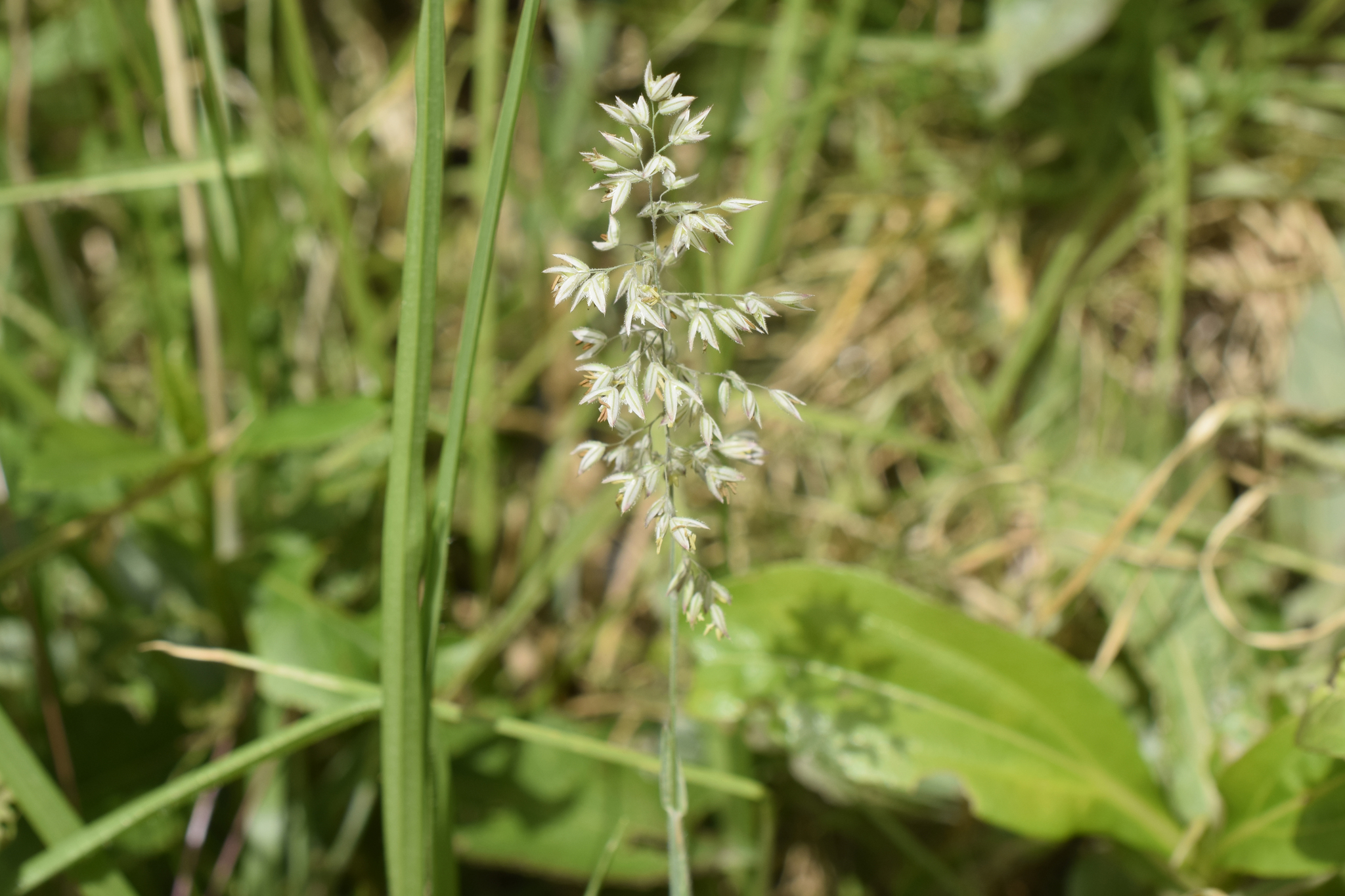
Arrhenatherum, commonly called oat-grass or button-grass, is a genus of Eurasian and North African plants in the grass family.
Description
Wild forms can resemble wild oat (Avena) or fescue (Festuca). Oat-grasses are very common perennials with yellowish roots. The shining stems grow to a height of 1.80 m (6 ft), but die off in winter. The leaves are hairless with blunt ligules. The inflorescence is a panicle with two-flowered bisexual spikelets.
Species
Arrhenatherum album - tall oat-grass - Mediterranean from Portugal to Cyprus
Arrhenatherum calderae - Tenerife in Canary Islands
Arrhenatherum elatius - false oat-grass, tall oat-grass, tall meadow oat - Eurasia + North Africa from Iceland to Canary Islands + Kazakhstan; naturalized in East Asia, Australia, New Zealand, the Americas
Arrhenatherum kotschyii - Turkey, Caucasus, Syria, Lebanon, Palestine, Jordan, Iraq, Iran, Afghanistan
Arrhenatherum longifolium - France, Spain, Portugal, Morocco
Arrhennatherum palaestinum - eastern Mediterranean from Greece to Iraq
Arrhenatherum pallens - Portugal
Formerly included
Numerous species are now considered better placed in other genera: Avenula, Danthoniastrum, Duthiea, Helictochloa, Helictotrichon and Sphenopholis.
In culture
Arrhenatherum remains are found in northern European burials from the Iron Age but disappear after Christianisation. It has been argued that they are included in the Old Norse category of laukar ('leeks') and may have reflected the rebirth of the dead, or as protection during their journey to the afterlife.