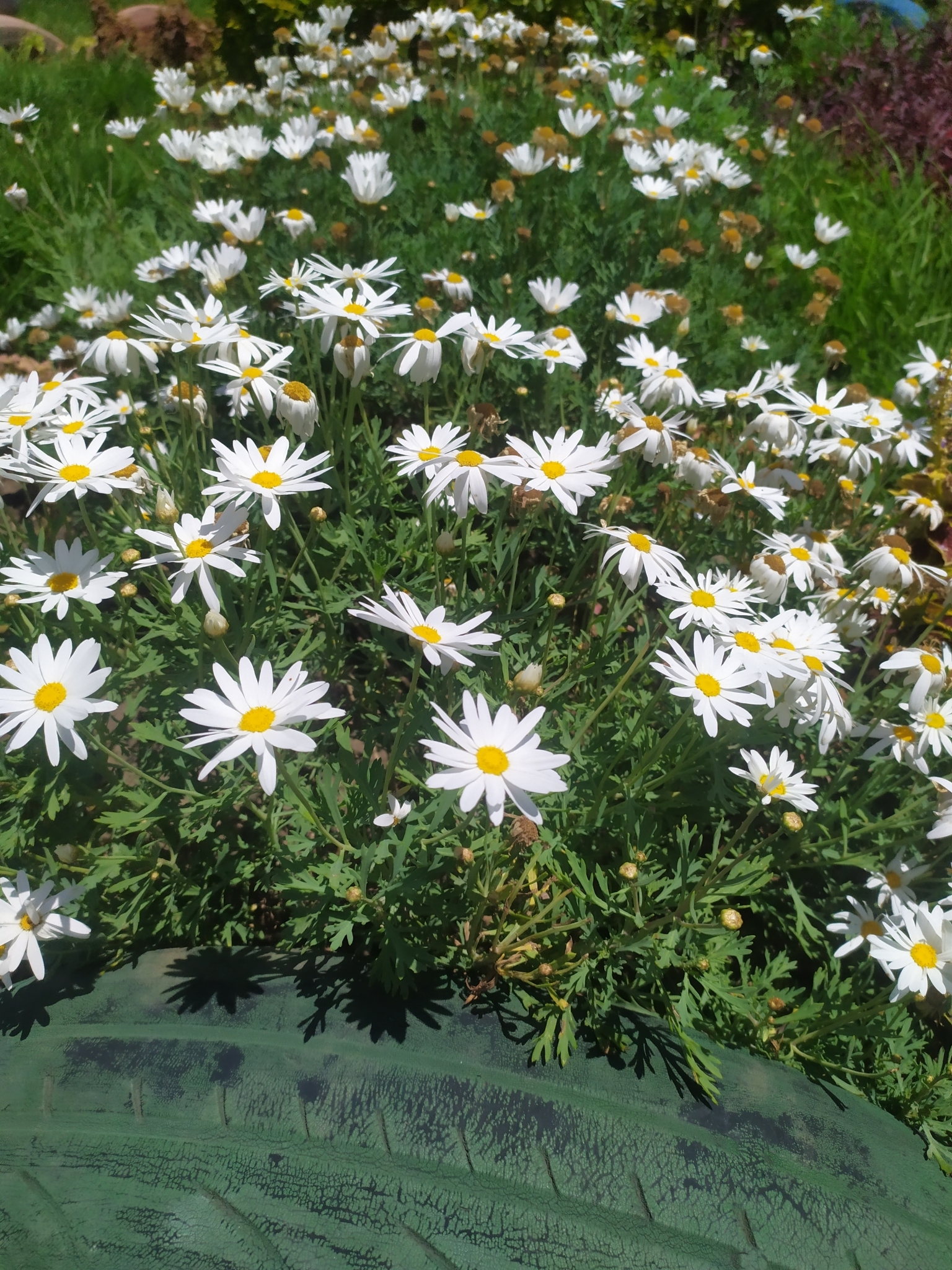
Argyranthemum frutescens, known as Paris daisy, marguerite or marguerite daisy, is a perennial plant known for its flowers. It is native to the Canary Islands (part of Spain). Hybrids derived from this species (garden marguerites) are widely cultivated as ornamental plants in private gardens and public parks in many countries, and have naturalized in Italy and southern California. There are many cultivars, but the most common has white petals.
Description
It is a perennial shrub that grows to about 20–80 cm (7.9–31.5 in). The strongly branched plant often grows globose-bushy with ascending to upright branches. The alternate, more or less fleshy and blue-green leaves are in outline oval to oval-lanceolate, 1–8 cm (0.4–3.1 in) long and 4–6 cm (1.6–2.4 in) wide. The foliage is green. The inflorescences are loose with 4 to 30 daisy-like flower heads, white with a yellow center, up to 2 cm (0.79 in) in diameter.
In most subspecies, the ligules of the ray florets are about 8 mm long, pure white, female and form fertile achenes, which are triangular to horn-like winged. The achenes of the yellow tubular central flowers are sterile and one-winged. The pappus is always irregularly crown-shaped. The flower is very fragrant. The flower opens its petals in the morning and closes them at night.
Like the other Argyranthemum species, the shrub marguerite originates from the Canary Islands. On El Hierro, La Gomera, Tenerife and Gran Canaria it is common in the coastal regions, on La Palma very rare. Overall, it is the most common species of the genus in the Canary Islands. The plant often grows in succulent shrubbery on...