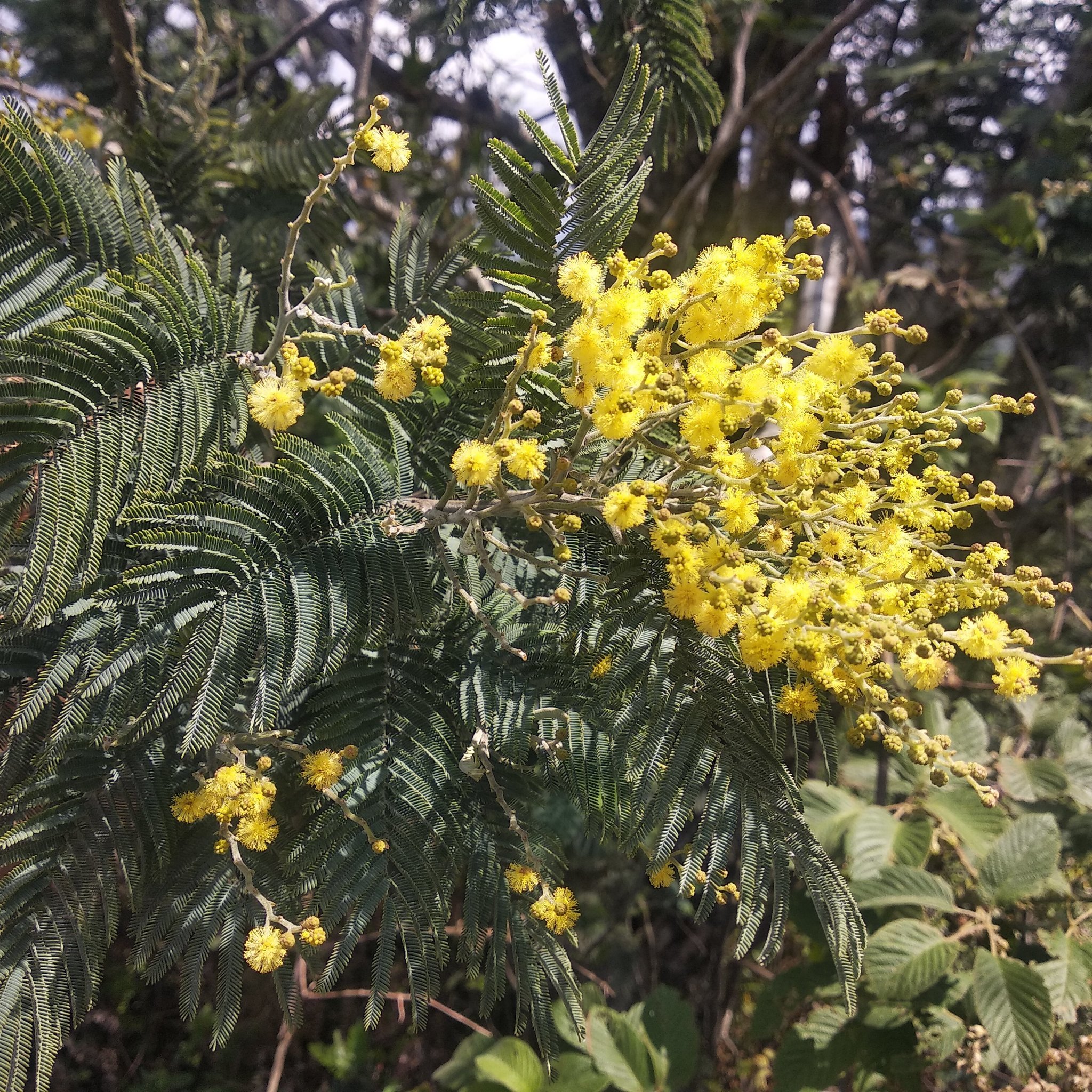
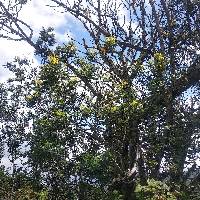
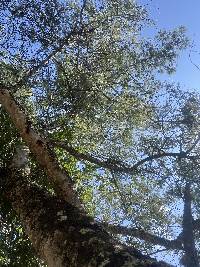
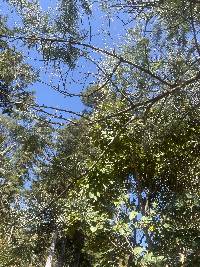
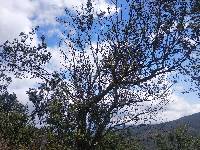
Acacia dealbata, commonly known as silver wattle, blue wattle or mimosa, is a species of flowering plant in the legume family, Fabaceae. It is endemic to south-eastern mainland Australia but it can be found as an introduced or invasive species elsewhere. It is a bushy shrub or spreading tree with smooth bark, bluish grey or silvery and glaucous bipinnate leaves, spherical heads of yellow to bright yellow flowers, and straight to slightly curved pods. The Wiradjuri people of New South Wales use the name giigandul for the species.
Description
Acacia dealbata is an erect, bushy shrub or spreading tree that typically grows to a height up to 30 m (98 ft) and has smooth grey, brown or dark brown bark, deeply corrugated when old. The leaves are bipinnate, on a petiole up to 15 mm (0.59 in) long, with 6 to 30 pairs of pinnae, each with 10 to 68 pairs of narrowly oblong to linear pinnules 0.7–5 mm (0.028–0.197 in) long and 0.4–0.8 mm (0.016–0.031 in) wide. The leaves are bluish grey or silvery and glaucous. The flowers are borne in spherical heads in racemes or in panicle-like groups on a hairy peduncle 2–10 mm (0.079–0.394 in) long, each head with 13 to 42 yellow to bright yellow flowers. Flowering occurs from July to November, and the pods are straight to slightly curved, more or less flat and often slightly constricted between some or all of the seeds, slightly leathery, blue or purplish, with a white, powdery bloom.
Taxonomy
Acacia dealbata was first formally described in 1822 by Johann Heinrich Friedrich Link in his Enumeratio Plantarum Horti Botanici Regii Berolinensis Altera.
Along with other bipinnate wattles, A. dealbata is classified in the section Botrycephalae within the subgenus Phyllodineae in the genus Acacia. An analysis of genomic and chloroplast DNA along with morphological characters found that the section is polyphyletic, though the close relationships of many species were unable to be resolved....