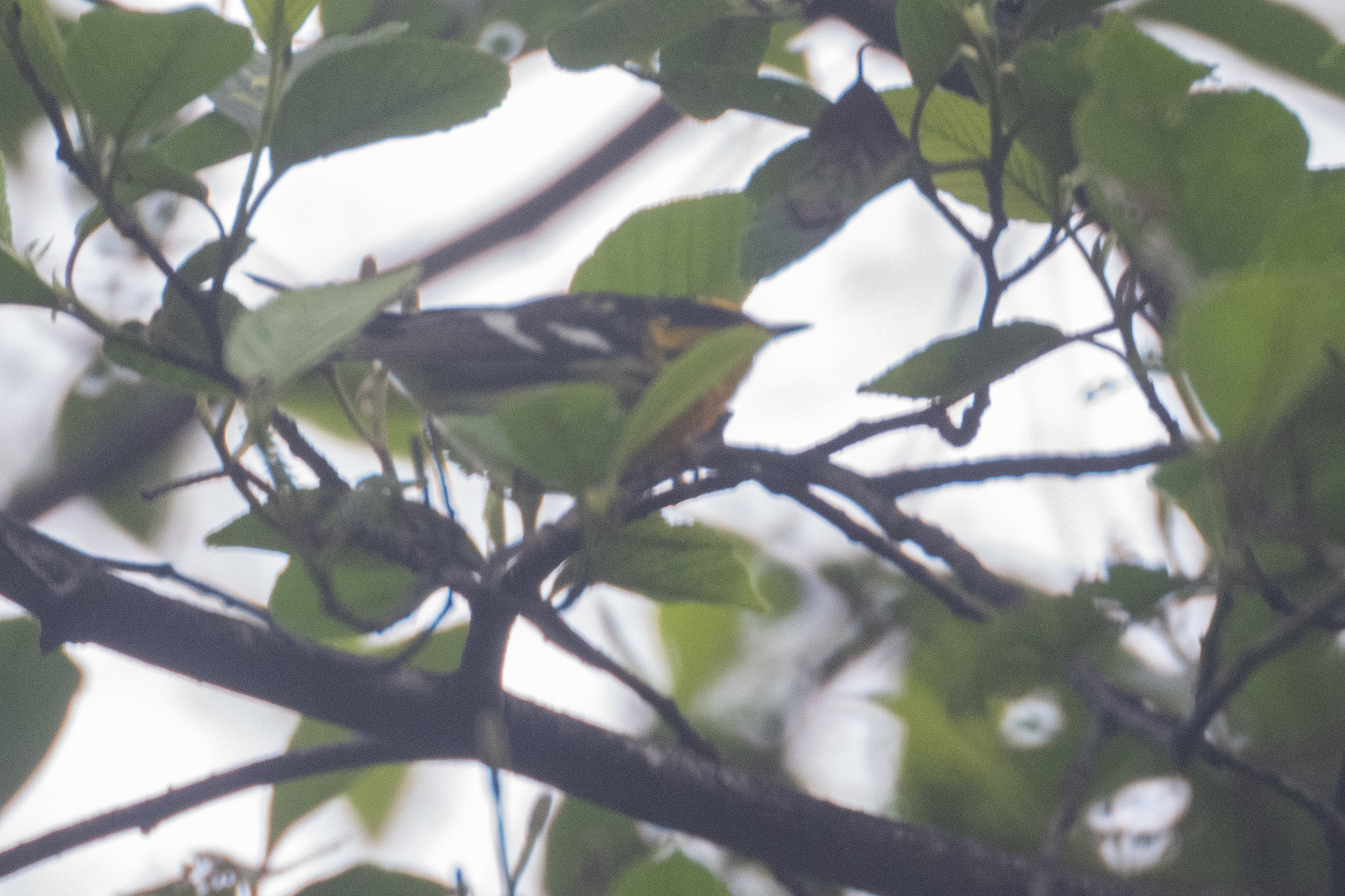
The Blackburnian warbler (Setophaga fusca) is a small New World warbler. They breed in eastern North America, from southern Canada, westwards to the southern Canadian Prairies, the Great Lakes region and New England, to North Carolina. They are migratory, wintering in southern Central America and South America, and are very rare vagrants to western Europe. The common name honors the English botanist Anna Blackburne.
Taxonomy
The Blackburnian warbler was formally described in 1776 by the German zoologist Philipp Statius Müller under the binomial name Motacilla fusca. The specific epithet is Latin meaning "dusky", "black" or "brown". Müller based his account on a handcoloured plate of the "Figuier étranger" that had been engraved by François-Nicolas Martinet to accompany the Comte de Buffon's multivolume work Histoire Naturelle des Oiseaux. The type location is French Guiana. The Blackburnian warbler is now placed in the genus Setophaga that was introduced by the English naturalist William Swainson in 1827. The genus name Setophaga combines the Ancient Greek σης/sēs, σητος/sētos meaning "moth" with -φαγος/-phagos meaning "-eating". The species is monotypic: no subspecies are recognised. The common name was introduced in 1785 by the Welsh naturalist Thomas Pennant to honour Anna Blackburne, an English botanist.
Description
Singing in the Porcupine Mountains, Michigan
Problems playing this file? See media help.
Blackburnian warblers are small passerines and average-sized wood-warblers. They measure around 11 to 13 cm (4.3 to 5.1 in) long, with a 20 to 22 cm (7.9 to 8.7 in) wingspan, and weigh 8 to 13 g (0.28 to 0.46 oz). The average mass of an adult bird is 9.7 g (0.34 oz), although is slightly higher in fall due to fat reserves, averaging 10.2–10.4 g (0.36–0.37 oz). Among standard measurements, the wing chord is 6.3 to 7.3 cm (2.5 to 2.9 in), the tail is 4.2 to 5 cm (1.7 to 2.0 in),...