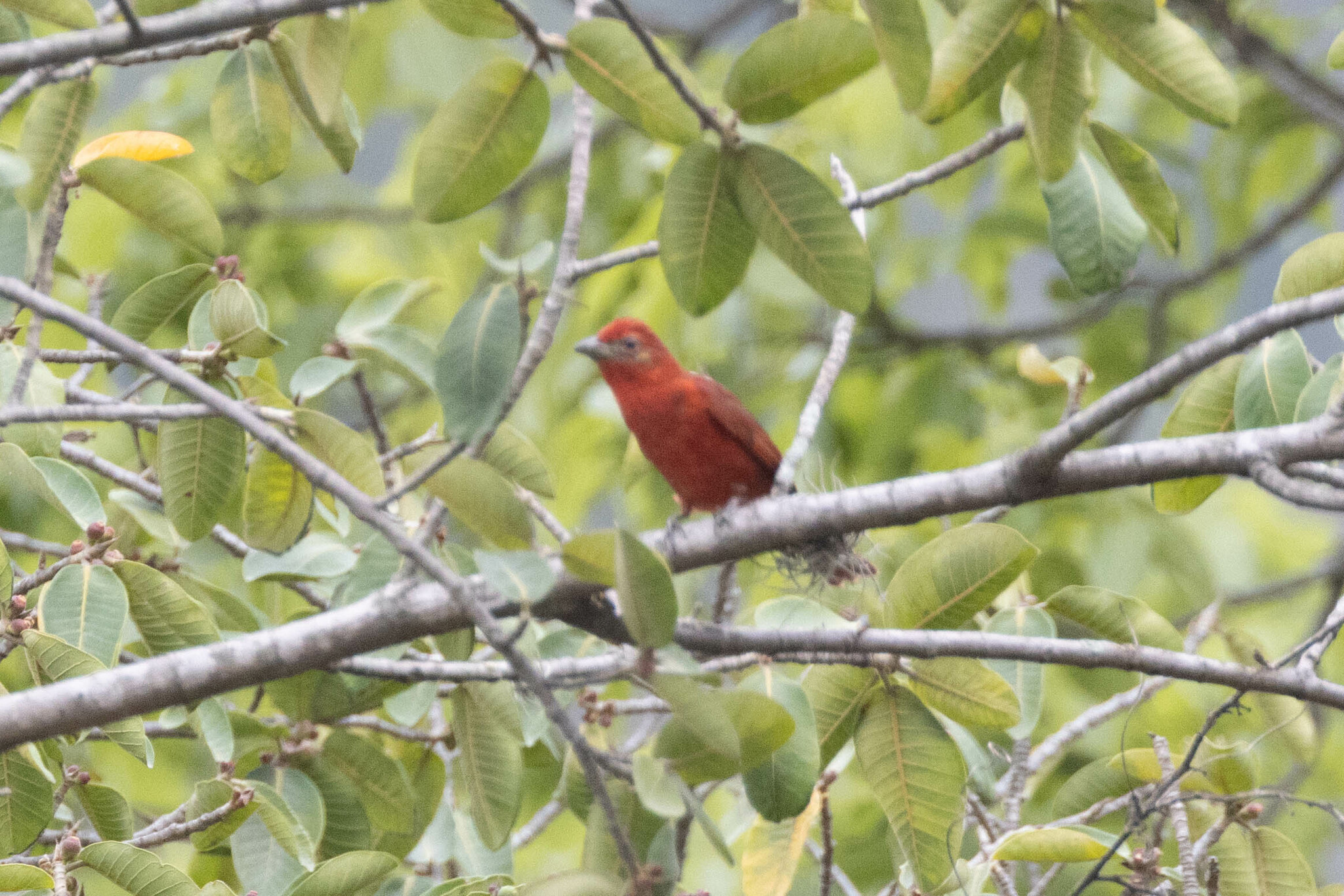
Piranga is a genus of birds long placed in the tanager family, but now considered members of the family Cardinalidae. The genus name Piranga is from Tupi word tijepiranga, the name for an unknown small bird.
Similar in shape and habits to the true tanagers, their coloration betrays their actual relationships. They are essentially red, orange, or yellow all over, except the tail and wings, and in some species also the back. Such extensive lipochrome coloration (except on the belly) is very rare in true tanagers, but is widespread among the Cardinalidae.
These songbirds are found high in tree canopies, and are not very gregarious in their breeding areas. Piranga species pick insects from leaves, or sometimes in flight. They also take some fruit. Several species are migratory, breeding in North America and wintering in the tropics.
Taxonomy and species list
The genus Piranga was introduced by the French ornithologist Louis Pierre Vieillot in 1808 with the summer tanager (Piranga rubra) as the type species. The genus name Piranga is from the Tupi Tijepiranga, the name for an unknown small bird.
Genus Piranga – Vieillot, 1808 – eleven species
Common name
Scientific name and subspecies
Range
Size and ecology
IUCN status and estimated population
Flame-colored tanager Male
Female
Piranga bidentata Swainson, 1827
Four subspecies
P. b. bidentata
P. b. flammea
P. b. sanguinolenta
P. b. citrea
Mexico, and throughout Central America to northern Panama
Size:
Habitat:
Diet:
LC
Red-headed tanager Male
Piranga erythrocephala (Swainson, 1827)
Mexico
Size:
Habitat:
Diet:
LC
Hepatic tanager Male
Female
Piranga hepatica Swainson, 1827
Five subspecies
P. h. hepatica Swainson, 1827
P. h. dextra Bangs, 1907
P. h. figlina Salvin &...