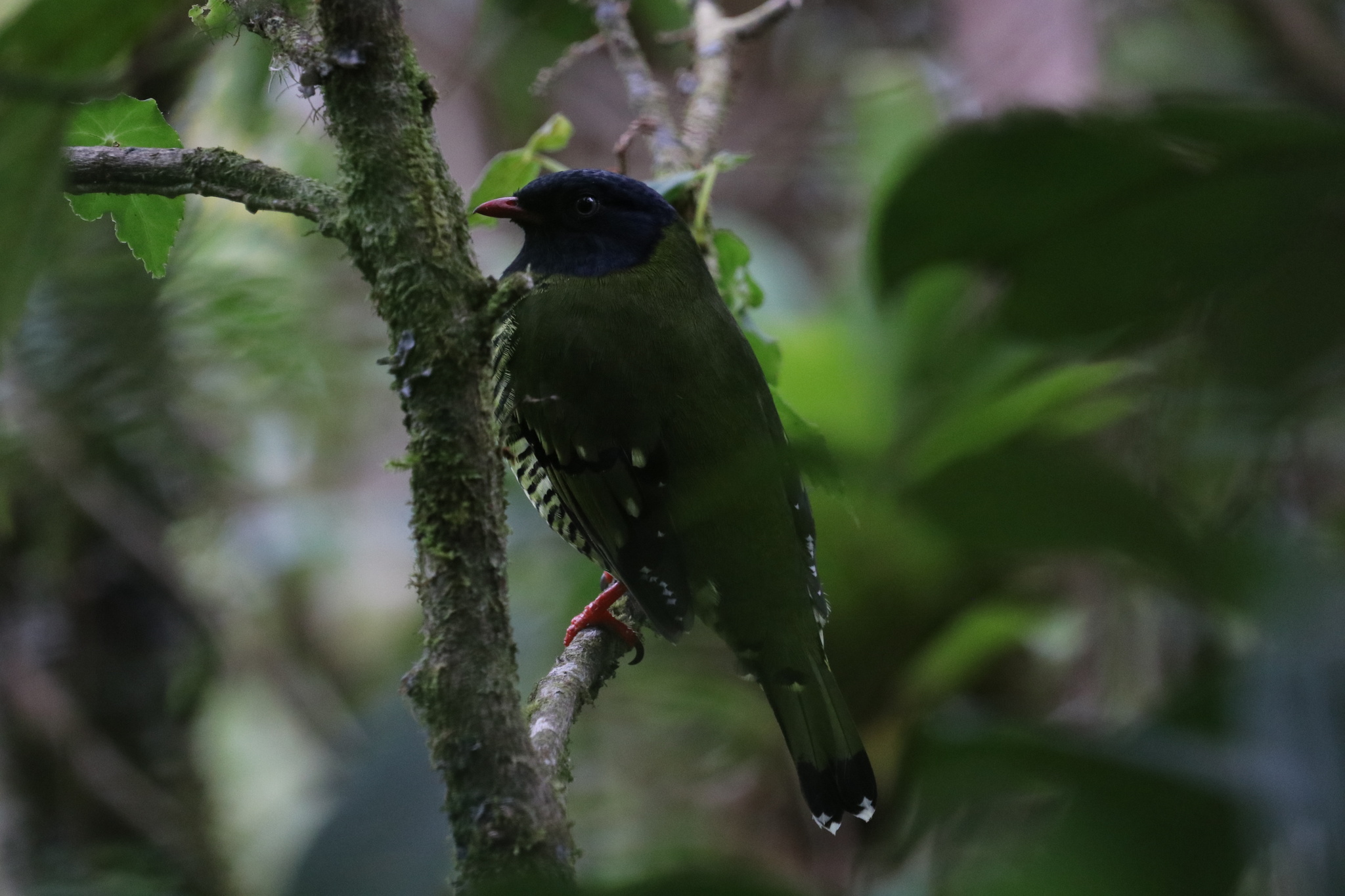
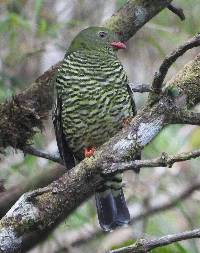
The barred fruiteater (Pipreola arcuata) is a species of bird in the family Cotingidae, the cotingas. It is found in Bolivia, Colombia, Ecuador, Peru, and Venezuela.
Taxonomy and systematics
The barred fruiteater was originally described as Ampelis arcuata.
The barred fruiteater has two subspecies, the nominate P. a. arcuata (Lafresnaye, 1843) and P. a. viridicauda (Meyer de Schauensee, 1953).
Illustration by Joseph Smit
Description
The barred fruiteater is among the largest of its genus at 22 to 23 cm (8.7 to 9.1 in) long and weighing 112 to 128 g (4.0 to 4.5 oz). The sexes have different plumage, though uniquely among the fruiteaters both have barred breasts. Adult males of the nominate subspecies have an entirely black head, neck, and upper breast. Their upperparts are olive-green and the wings and tail mostly that color. The wing's greater coverts and tertials have large yellow spots. The tail has a black bar near the end and whitish tips on the feathers. Their underparts are yellow with crisp black bars. Females have an olive-green head instead of the male's black and the black-barred yellow of the underparts includes the throat and upper breast. Both sexes have a red, orange, yellow, or chestnut iris, a crimson bill with sometimes a black tip, and scarlet legs and feet. Subspecies P. a. viridicauda has pale yellow to creamy eyes and less black and white on its outer tail feathers than the nominate.
Distribution and habitat
The barred fruiteater has a disjunct distribution. The nominate subspecies has the much larger range, though it is discontinuous. It is found in the Serranía del Perijá that straddles the Colombia-Venezuela border, in the Andes of Venezuela from Lara west into Colombia's eastern Andes, from Colombia's central and western Andes south through the Andes of Ecuador into far northern Peru's Piura Department, and on the eastern slope of the Andes of Peru from Amazonas south to Pasco Department. Subspecies P. a. viridicauda is found on the eastern slope of the...