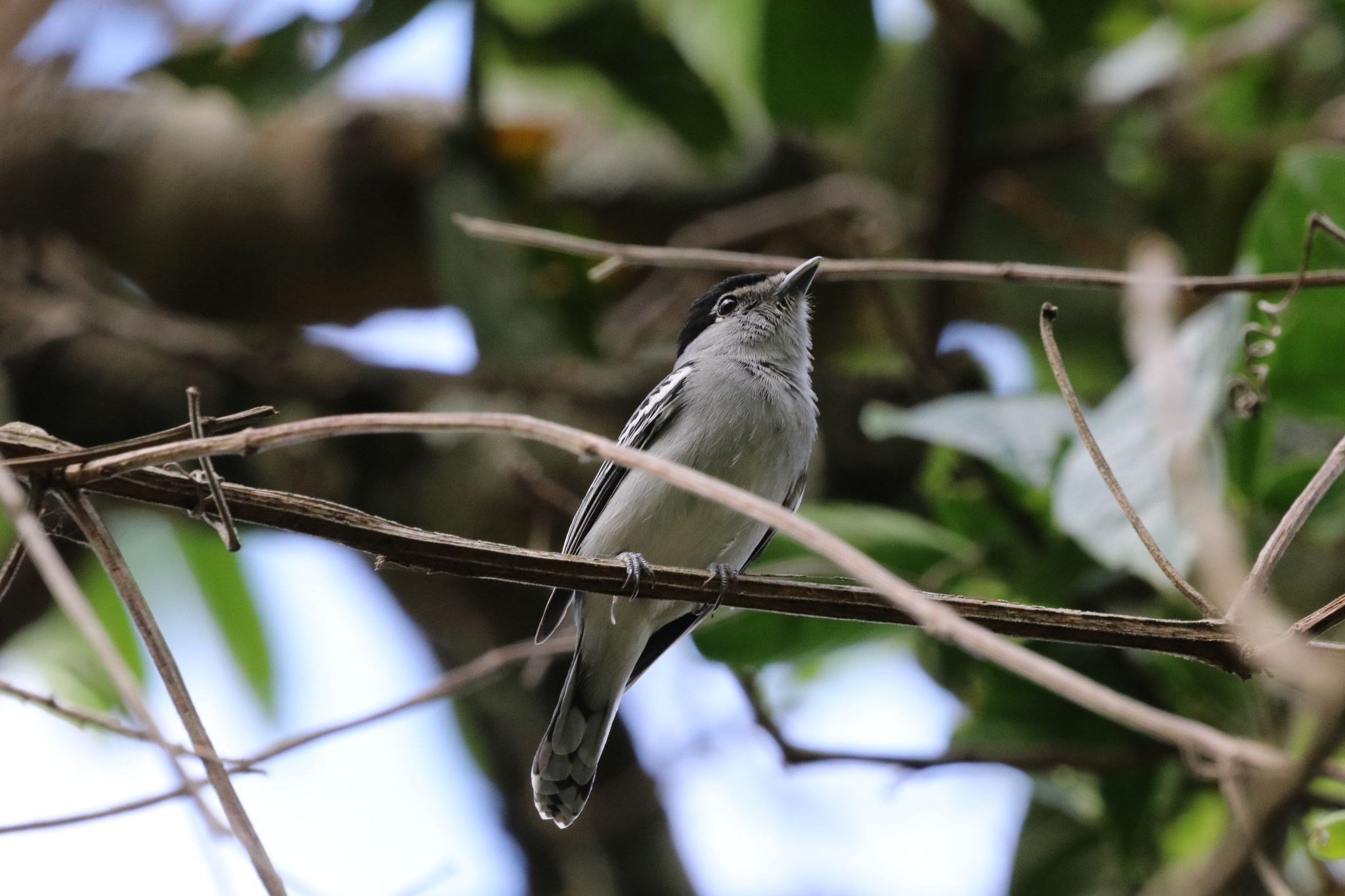
The black-and-white becard (Pachyramphus albogriseus) is a species of bird in the family Tityridae, the tityras, becards, and allies. Sources differ on its range; all agree it is found in Colombia, Costa Rica, Panama, and Venezuela and some add Ecuador and Peru.
Taxonomy and systematics
The black-and-white becard was originally described in 1857 as Pachyramphus albo-griseus. The genus Pachyramphus has variously been assigned to the tyrant flycatcher family Tyrannidae and the cotinga family Cotingidae. Several early twenty-first century studies confirmed the placement of Pachyramphus in Tityridae and taxonomic systems made the reassignment. In 1998 the American Ornithological Society was unsure where to place the genus and listed its members as incertae sedis but in 2011 moved them to Tityridae.
The black-and-white becard's further taxonomy is unsettled. Until publication of a 2023 study taxonomists assigned it five subspecies. Following that study the IOC, the Clements taxonomy, AviList, the North American Classification Committee of the American Ornithological Society (NACC), and the independent South American Classification Committee (SACC) retained two of them, the nominate P. a. albogriseus (Sclater, PL, 1857) and P. a. ornatus (Cherrie, 1891). They split off P. a. salvini as the monotypic cryptic becard and merged P. a. coronatus and P. a. guayaquilensis into it. However, as of late 2025 BirdLife International's Handbook of the Birds of the World (HBW) retains the older five-subspecies treatment of the black-and-white becard.
The sources that assign two subspecies also do not agree on the species' range. All agree that P. a. ornatus is found in Costa Rica and Panama. They also agree that P. a. albogriseus is found in Colombia and Venezuela. The IOC, NACC, and SACC include Ecuador and Peru in the range of albogriseus; Clements and AviList do not.
This article follows the IOC/NACC/SACC model of two subspecies with a six-country range.