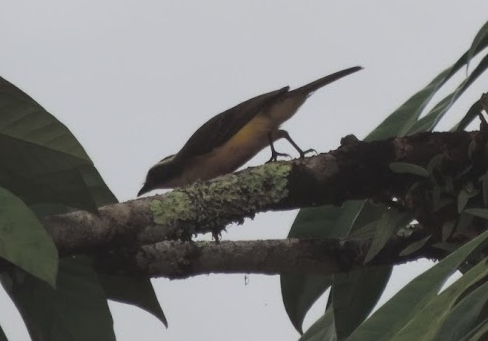
The social flycatcher (Myiozetetes similis) is a passerine bird from the Americas, a member of the large tyrant flycatcher family Tyrannidae. It is found in Mexico, every Central American country, and every mainland South American country except Chile, Guyana, Suriname, and Uruguay. It has also occurred as a vagrant in the United States.
Taxonomy and systematics
The social flycatcher was originally described in 1825 as Muscicapa similis, mistakenly placing it in the Old World flycatcher family.
The social flycatcher has these seven subspecies:
M. s. primulus Van Rossem, 1930
M. s. hesperis Phillips, AR, 1966
M. s. texensis (Jacob Post Giraud Jr, 1841)
M. s. columbianus Cabanis & Heine, 1860
M. s. similis (Spix, 1825)
M. s. grandis Lawrence, 1871
M. s. pallidiventris Pinto, 1935
In the early twentieth century some authors treated M. s. texensis as a separate species. By itself and also with M. s. primulus and M. s. hesperis it was called the vermilion-crowned flycatcher. (At least one author used "vermilion-crowned" for the entire social flycatcher.) A 2023 field guide treats each of M. s. texensis, M. s. columbianus, M. s. grandis, and M. s. pallidiventris as separate species. Within the full species the Clements taxonomy groups M. s. primulus, M. s. hesperis, and M. s. texensis as the "social flycatcher (vermilion-crowned)", groups M. s. similis, M. s. columbianus, and M. s. pallidiventris as the "social flycatcher (social)", and calls M. s. grandis the "social flycatcher (Tumbes)".
The social flycatcher's specific epithet similis is from the Latin similis or simile meaning "similar" or "resembling". The species closely resembles several other flycatchers including the congeneric rusty-margined flycatcher (M. cayanensis), the great and lesser kiskadees (Pitangus sulphuratus and Philodor lictor), and the three-striped flycatcher (Conopias trivirgatus).