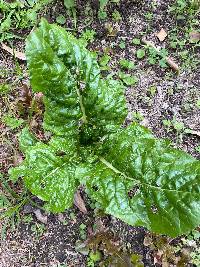
Beta vulgaris (beet) is a species of flowering plant in the subfamily Betoideae of the family Amaranthaceae. It is a perennial plant usually growing up to 120 centimetres (4 ft) tall.
Three subspecies are typically recognised. The wild ancestor of all the cultivated beets is the sea beet (Beta vulgaris subsp. maritima), with several modern cultivars all belonging to B. vulgaris subsp. vulgaris.
Some of the most popular cultivar groups include: the sugar beet (used to produce table sugar), the root vegetable known as the beetroot or garden beet, the leaf vegetable known as chard or spinach beet or silverbeet, and mangelwurzel (a fodder crop).
Description
Flowers of Beta vulgaris
Beta vulgaris is a herbaceous biennial or, rarely, perennial plant up to 120 centimetres (4 ft) in height, rarely 200 cm; cultivated forms are mostly biennial. The roots of cultivated forms are dark red, white, or yellow and moderately to strongly swollen and fleshy (subsp. vulgaris); they are brown, fibrous, sometimes swollen, and woody in the wild subspecies. The stems grow erect or, in the wild forms, often procumbent; they are simple or branched in the upper part, and their surface is ribbed and striate. The basal leaves have a long petiole (which may be thickened and red, white, or yellow in some cultivars). The simple leaf blade is oblanceolate to heart-shaped, dark green to dark red, slightly fleshy, usually with a prominent midrib, with entire or undulate margin, 5–20 cm long on wild plants (often much larger in cultivated plants). The upper leaves are smaller, their blades are rhombic to narrowly lanceolate.
The flowers are produced in dense spike-like, basally interrupted inflorescences. Very small flowers sit in one- to three- (rarely eight-) flowered glomerules in the axils of short bracts or in the upper half of the inflorescence without bracts. The hermaphrodite flowers are urn-shaped, green or tinged reddish, and consist of five basally connate perianth...