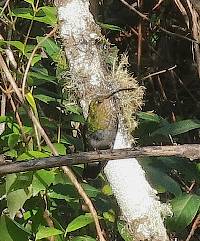
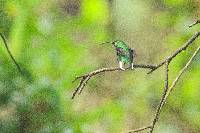
The mountain velvetbreast (Lafresnaya lafresnayi) is a species of hummingbird in the "brilliants", tribe Heliantheini in subfamily Lesbiinae. It is found in Colombia, Ecuador, Peru, and Venezuela.
Taxonomy and systematics
The mountain velvetbreast is the only member of its genus. Seven subspecies are recognized:
L. l. liriope Bangs (1910)
L. l. longirostris Schuchmann, Weller & Wulfmeyer (2003)
L. l. greenewalti Phelps & Phelps Jr (1961)
L. l. lafresnayi Boissonneau (1840)
L. l. saul Delattre & Bourcier (1846)
L. l. orestes Zimmer, JT (1951)
L. l. rectirostris Berlepsch & Stolzmann (1902)
male showing its black belly
L. l. saul, Ecuador
In the early 20th century at least one author treated L. l. liriope and L. l. saul as separate species.
Description
The mountain velvetbreast is 11.5 to 12 cm (4.5 to 4.7 in) long including its 2.7 to 3.2 cm (1.1 to 1.3 in) bill. It weighs 4.5 to 6.3 g (0.16 to 0.22 oz). Males have a thin decurved black bill whose length and curvature vary among the subspecies. The female's bill is less curved than the male's and also varies geographically. All subspecies have a white spot behind the eye.
Adult males of the nominate subspecies L. l. lafresnayi have grass green upperparts. Their throat and breast are iridescent emerald green and the belly velvet black. The central tail feathers are bronzy green and the rest buff with black tips. Adult females also have grass green upperparts. Their underparts are buff with iridescent green spots. Juveniles are similar to females but that females have the beginning of the black belly.
Males of the other subspecies have whitish, not buff, outer tail feathers, and females have white underparts rather than the nominate's buff. Most of the subspecies have minor differences in bill length and curvature from the nominate, but that of subspecies L. l. saul is more decurved and that of L. l. orestes is even more decurved. The most recently...