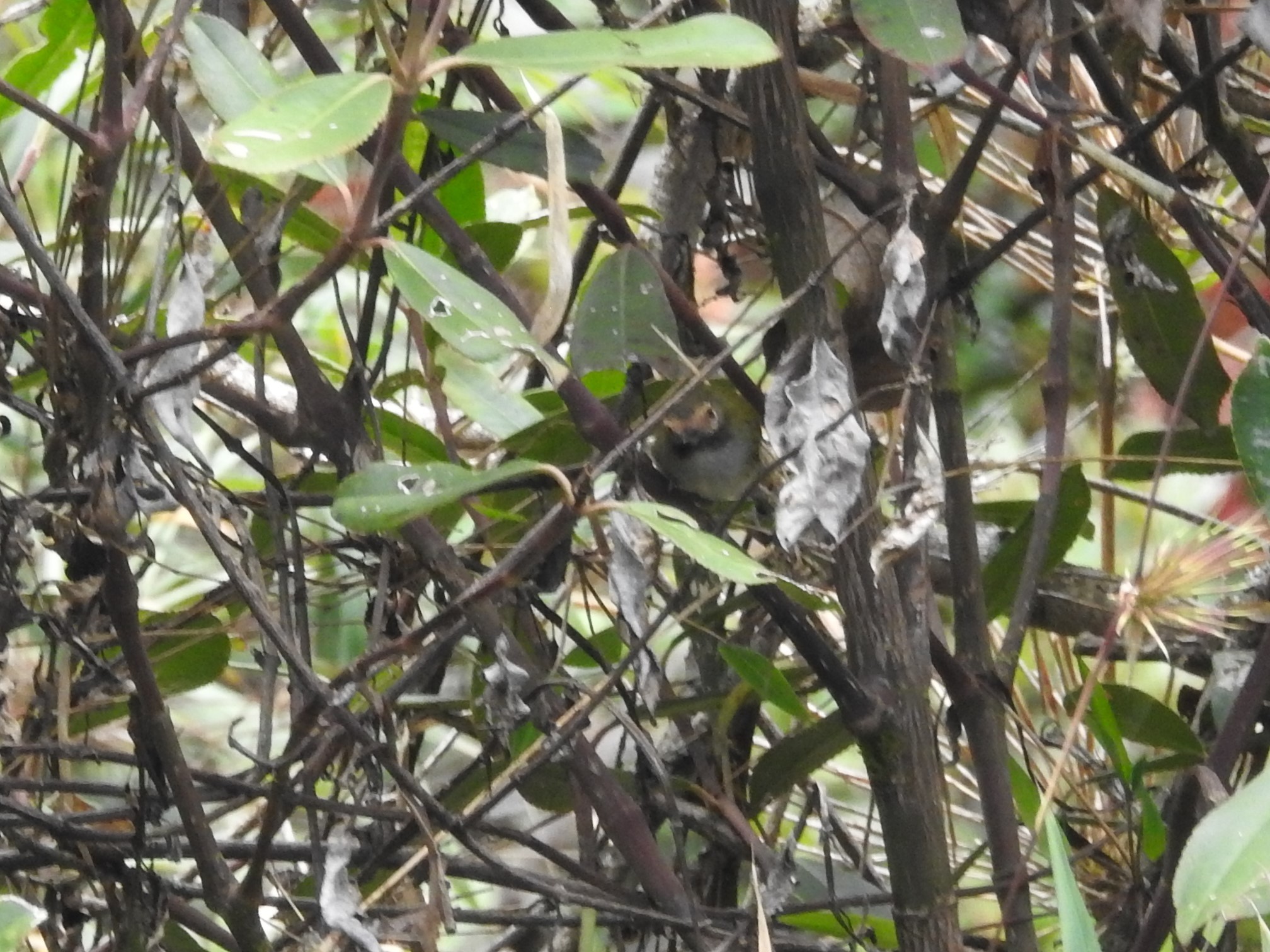
The black-throated tody-tyrant (Hemitriccus granadensis) is a species of bird in the family Tyrannidae, the tyrant flycatchers. It is found in Bolivia, Colombia, Ecuador, Peru, and Venezuela.
Taxonomy and systematics
The black-throated tody-tyrant has a complicated taxonomic history. It was originally described in 1843 as Todirostrum granadense. During the twentieth century it was successively placed in genera Euscarthmornis and Idiotilon, both of which were later merged into Hemitriccus.
The black-throated tody-tyrant has these seven subspecies:
H. g. lehmanni (Meyer de Schauensee, 1945)
H. g. intensus (Phelps, WH & Phelps, WH Jr, 1952)
H. g. federalis (Phelps, WH & Phelps, WH Jr, 1950)
H. g. andinus (Todd, 1952)
H. g. granadensis (Hartlaub, 1843)
H. g. pyrrhops (Cabanis, 1874)
H. g. caesius (Carriker, 1932)
Some authors have suggested that more than one full species is represented within these seven taxa.
Description
The black-throated tody-tyrant is 8.5 to 11 cm (3.3 to 4.3 in) long and weighs 6.5 to 8.5 g (0.23 to 0.30 oz). The sexes have the same plumage. Adults of the nominate subspecies H. g. granadensis have a dark olive crown. Their lores and wide eye-ring are whitish and their ear coverts grayish olive. Their back and rump are dark olive. Their wings are dark olive with indistinct yellow edges on the coverts. Their tail is dark dusky olive. Their upper throat and lower cheeks are sooty black and their lower throat whitish with grayish edges. They have a diffuse grayish band across the breast that fades to white on the lower breast and belly; their lower flanks and undertail coverts have a yellow tinge. All subspecies a black bill and gray to pinkish gray legs and feet. Most have a highly variable chestnut to pale orange iris.
The other subspecies of the black-throated tody-tyrant differ from the nominate and each other thus:
H. g. lehmanni: brighter and more yellowish green crown and upperparts than nominate, with buff lores and...