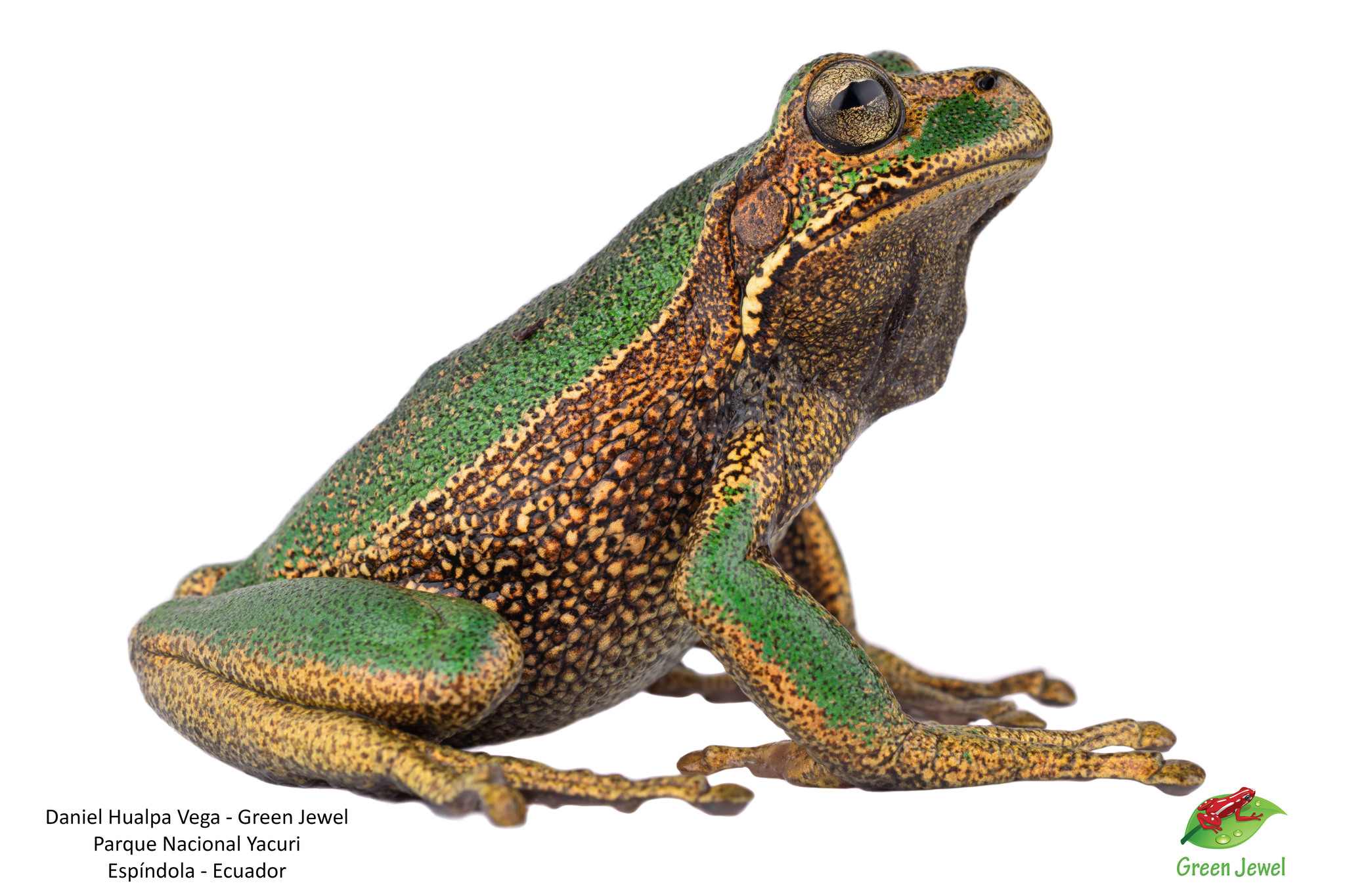
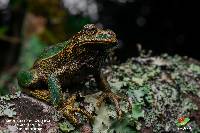
Gastrotheca turnerorum, or Turner's marsupial frog, is a frog. Scientists have found it in Ecuador and Peru.
Description
The adult male frog measures 50.0–55.6 mm in snout-vent length and the adult female frog 54.0–58.2 mm. The skin of the dorsum can be brown or green in color. The frog is covered with small dots, mostly cream-white or cream-yellow. Some of the lines on the face are made of bronze dots. The flanks are dark brown to bronze in color with tiny cream-white dots. The belly is dark brown in color with cream-white dots. The iris of the eye is cream-yellow in color with dark brown reticulations and a thick dark brown horizontal bar across the whole eye.
Etymology
Scientists named this frog turnerorum for the Turner family and their work in conservation, preserving biodiversity, and environmental education.
Habitat
This nocturnal, semi-arboreal frog lives in paramo and sub-paramo. Scientists have reported these frogs between 2,899 m (9,511 ft) and 3,513 m (11,526 ft) above sea level.
Scientists have reported this frog in protected areas: Parque Nacional Yacuri, Parque Nacional Podocarpusa, and Reserva Tapichalaca.
Reproduction
The female frog carries her eggs in a pouch on her back. Scientists have found tadpoles in ponds and lagoons.
Threats
The IUCN classifies this frog as endangered. It faces habitat loss and habitat degratation from fires, agriculture, livestock cultivation, overtourism, pesticides, and introduced pathogens and other animals, such as trout.