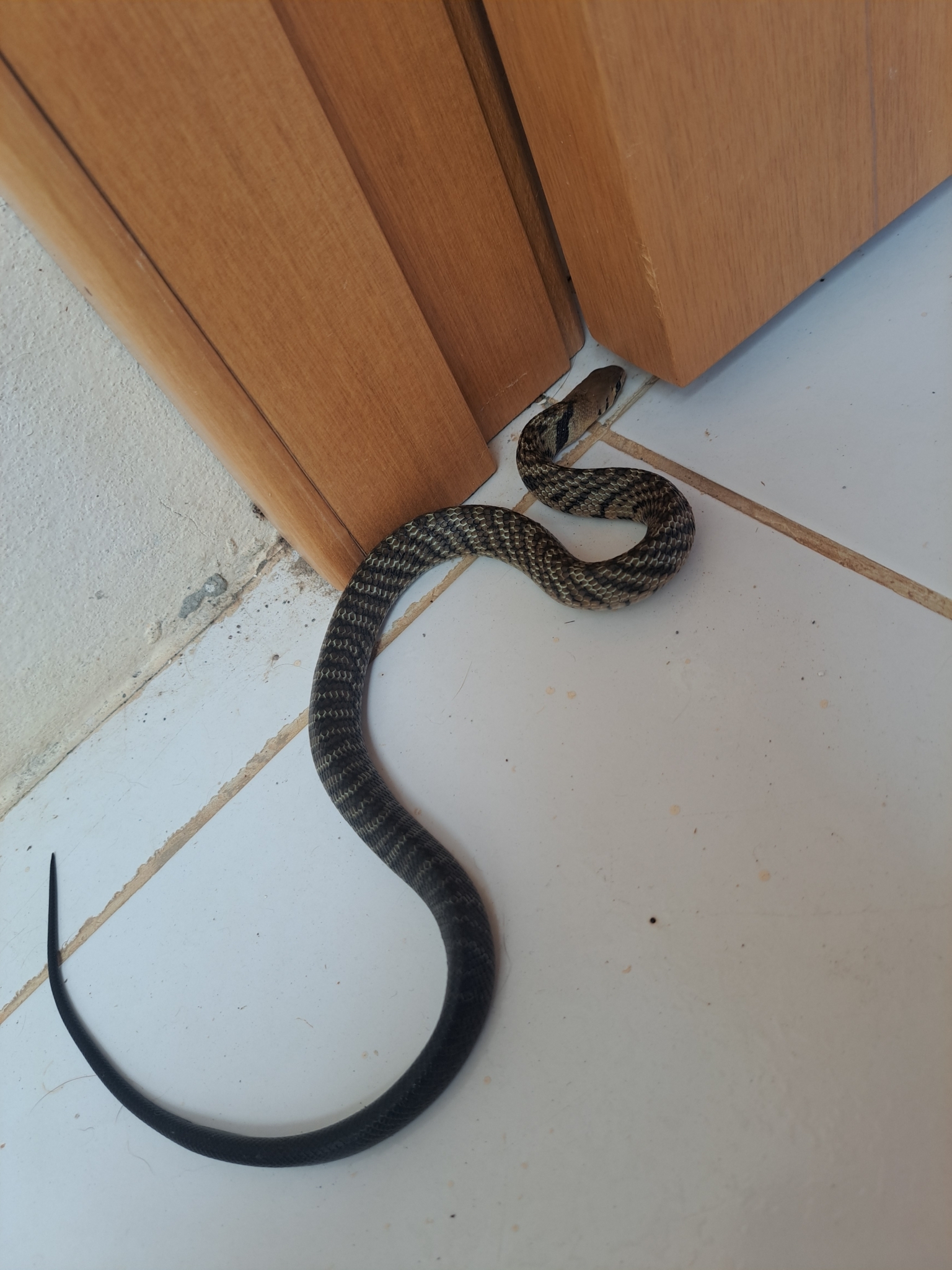
Drymarchon is a genus of large, nonvenomous, colubrid snakes, commonly known as indigo snakes or cribos, found in the Southeastern United States, Mexico, Central America, and South America.
Description
Indigo snakes are large, robust snakes. They have smooth dorsal scales, and several color variations, including a glossy blue-black color. The snake's generic name Drymarchon means "lord of the forest". The species in this genus are sexually dimorphic, with the males being larger than the females. This is thought to be due to intraspecies competition from the males.
Behavior and diet
Indigo snakes are diurnal and actively forage for prey. They feed on a broad variety of small animals such as rodents, birds, lizards, frogs, toads, and other snakes, including rattlesnakes.
Indigo snakes also eat small gopher tortoises when they are available. They are not aggressive snakes and bite only when threatened. Its typical threat display includes hissing and shaking of its tail as a warning.
Habitat
The current distribution of D. couperi extends from the coastal plain of southern Georgia to peninsular Florida and the lower Florida Keys west to Southeastern Mississippi. This species uses a variety of different habitats, including longleaf pine-turkey oak sandhills, pine and scrub flatwoods, dry prairie, tropical hardwoods, freshwater wetlands, and coastal dunes; however, winter survival, especially in northern portions of its range, depends on the availability of appropriate shelters, which are primarily gopher tortoise burrows. These burrows are used to hide from predators, fires, and extreme temperatures.
The Texas indigo snake ranges from central-eastern and northeastern Mexico to south and central Texas and lives in Tamaulipan thornscrub habitat.
The Yellow-tailed cribo (or Drymarchon corais) ranges throughout central and northern South America within the Amazon rainforest. They can be found in Brazil, Bolivia, Colombia, Ecuador, French Guiana, Guyana, Paraguay, Peru, Suriname and...